

If these essays have changed the way you see the world around you, the paid tier goes further.
You get longer, more researched pieces on the places that shaped Western civilization and the stories behind them. Deep dives into tradition, craftsmanship, and what the built world reveals about culture. Travel guides that teach you to actually read the places you visit.
This project is kept alive by people who care about old-world traditions. For a few dollars a month, you can be one of them.
There is a strange thing you notice when walking through the industrial parts of older European cities: some of the most attractive buildings were originally factories.
Look at an old textile mill in Manchester, a nineteenth-century brewery in Munich, a warehouse in Hamburg, or one of the enormous brick factories that still survive around London. These were working buildings filled with machinery, smoke, workers, raw materials, and noise, yet many were built with arched windows, carefully laid brickwork, stone entrances, decorative cornices, towers, courtyards, and façades that seem far more elaborate than a factory strictly needed.
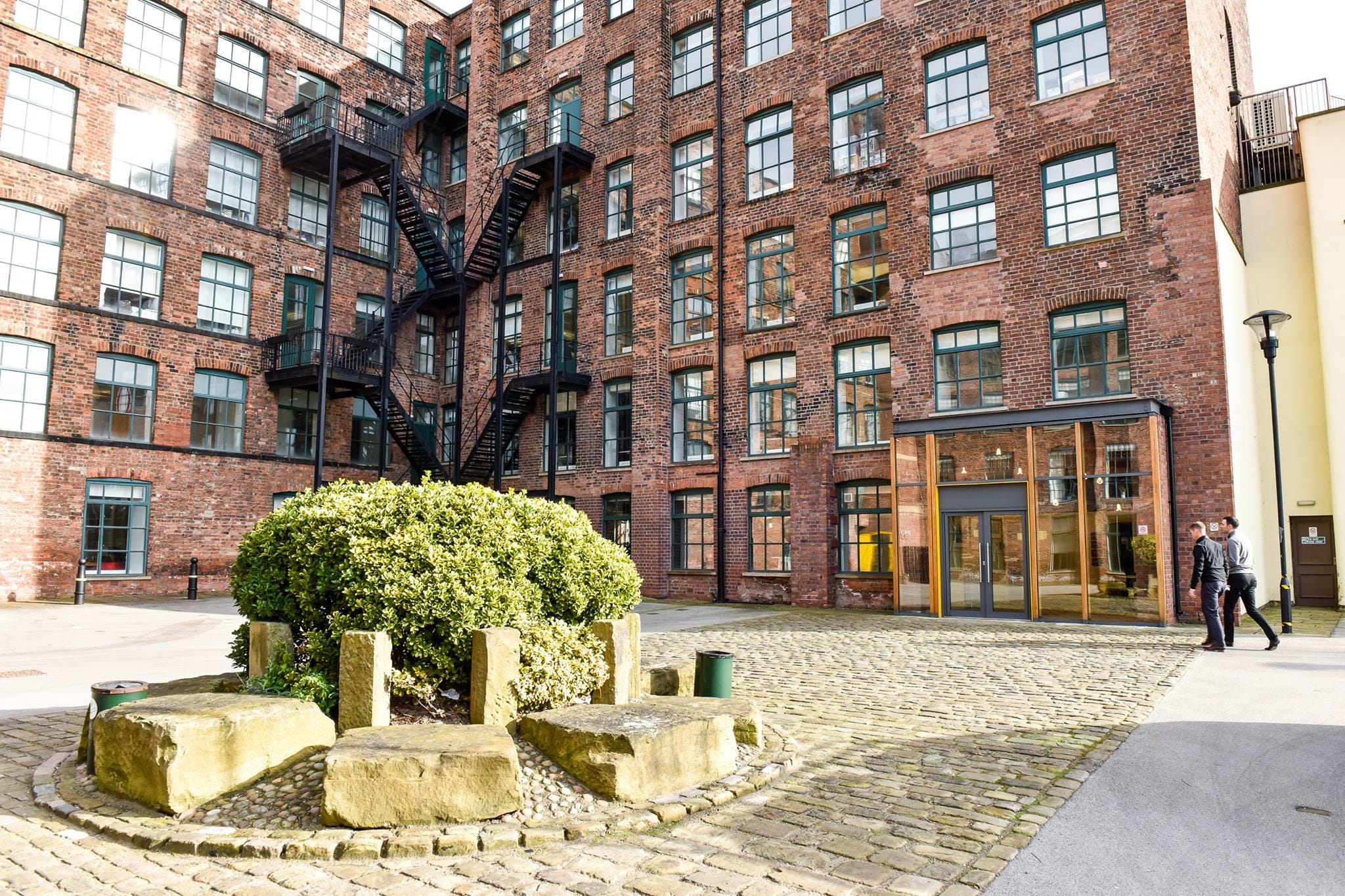
This becomes even stranger when you compare them with the industrial buildings we construct today.
Drive through the outskirts of almost any modern city and you will find factories and warehouses that look almost interchangeable: enormous rectangular boxes surrounded by parking lots, loading bays, fences, and roads. Their appearance makes perfect sense from the perspective of logistics, but it raises an interesting question.
Why did people once put so much effort into making factories beautiful?
The answer begins with the Industrial Revolution.
When the Factory Was a New Kind of Building
Before the eighteenth century, there was no factory architecture in the modern sense because there were very few factories in the modern sense.
Most manufacturing took place in workshops, homes, mills, yards, and small specialized buildings. A weaver might work from his own house, a blacksmith from a workshop, and a miller from a watermill beside a river. Production was scattered across towns and the countryside.
Industrialization changed this remarkably quickly.
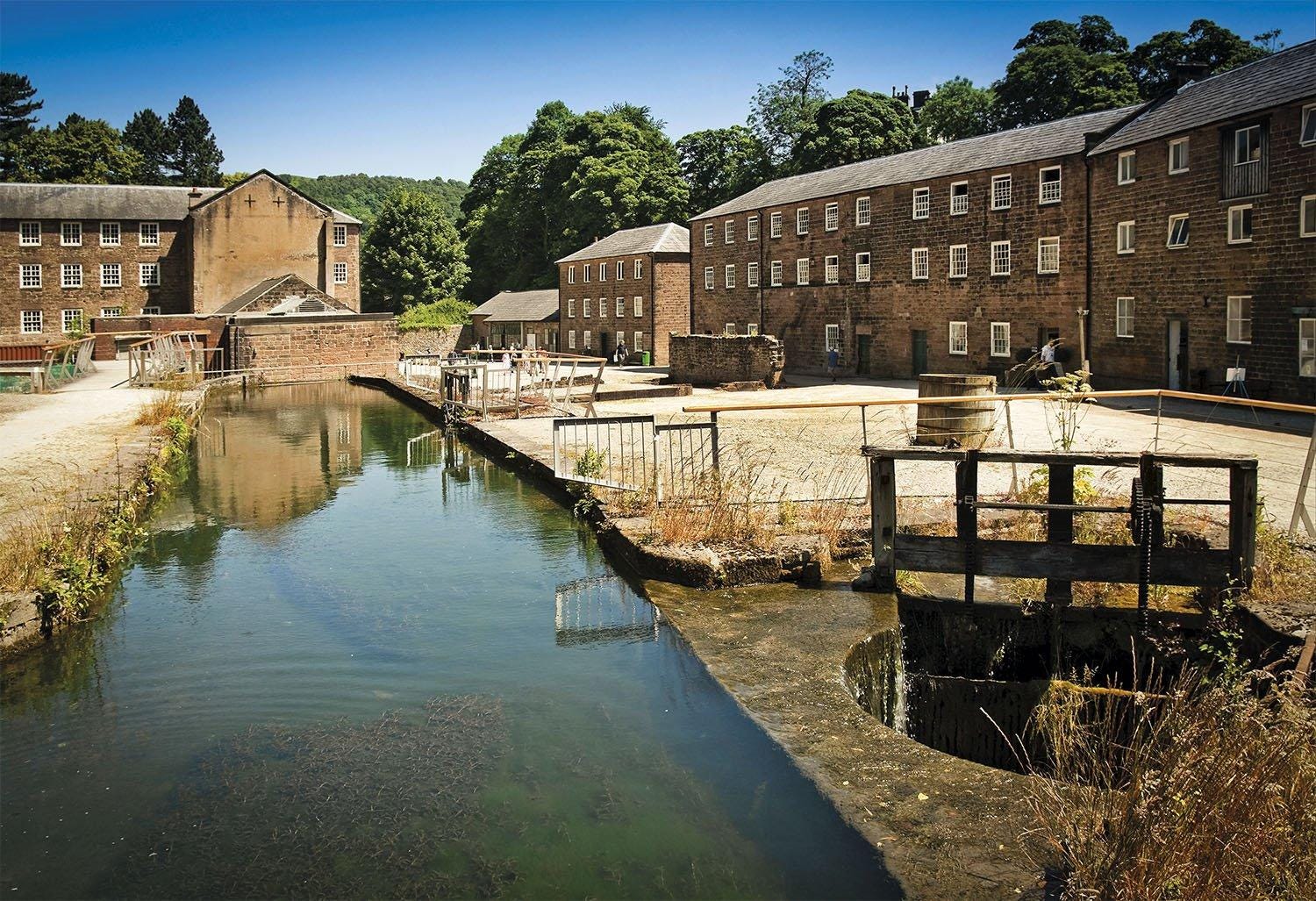
New machinery allowed production to be concentrated on a scale that had previously been impossible, while water power and later steam power meant that hundreds of workers and machines could operate under the same roof. Suddenly Britain needed an entirely new kind of building, and nobody had centuries of architectural precedent telling them what it should look like.
So the earliest factories borrowed from buildings people already knew.
Some resembled mills, which is hardly surprising given that many of them actually were mills. Others borrowed the proportions and architectural language of warehouses, country houses, civic buildings, and workshops. They had regular rows of windows because workers needed daylight, substantial masonry walls because the building needed to carry enormous loads, and tall chimneys because steam engines required boilers.
Function was already shaping the architecture.
But function did not mean the building had to be ugly.
And this is where things get interesting.
A Wall Could Still Be a Beautiful Wall
Take the great brick factories of nineteenth-century Britain.
A factory owner needed walls anyway, so builders could give those walls proportion and rhythm without fundamentally changing what the building was supposed to do. Windows could be arranged in orderly rows. An entrance could receive a stone surround. Brick could be laid into arches, bands, recessed panels, pilasters, and cornices. The roofline could be given a clear termination instead of simply stopping.
None of this required turning a cotton mill into Versailles.
It simply meant that the practical parts of the building were treated architecturally.
Brick was especially well suited to this. Builders could create an astonishing amount of decoration simply by changing the way ordinary bricks were laid, projecting certain courses from the wall, recessing others, forming arches over windows, or introducing different patterns around entrances and rooflines.
This is one reason old industrial buildings can look so good even when they are extremely simple.
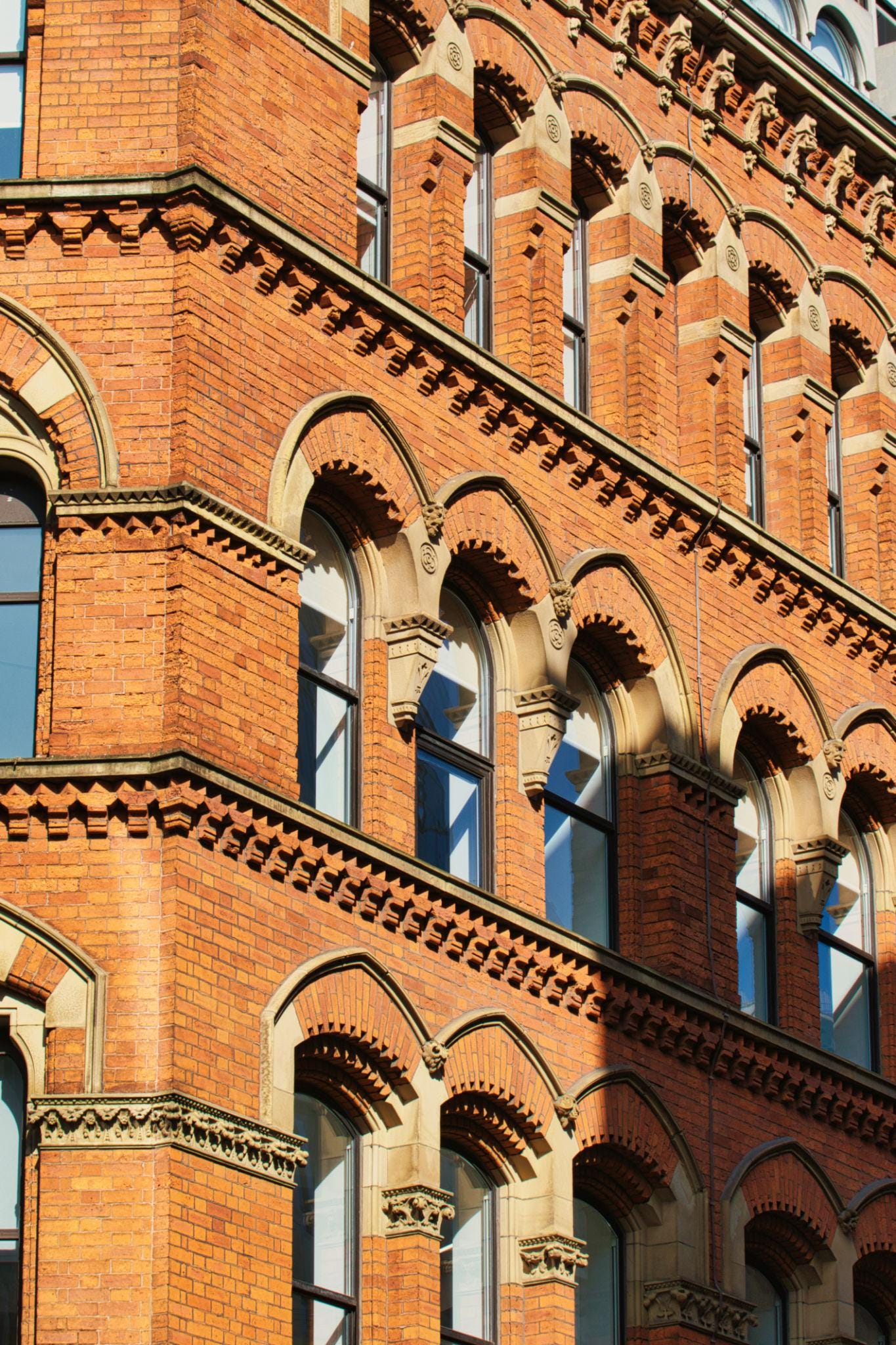
They have rhythm.
A long factory façade might contain fifty nearly identical windows, but those windows form a pattern. Floors are visually separated. Corners are emphasized. The entrance tells you where to go. The roof tells you where the building ends.
The factory still looks like a factory.
It simply looks like somebody cared.
Visitors noticed this even at the time. Writing about Huddersfield, the German observer Jakob Venedey admitted that industry could produce a kind of unexpected picturesqueness:
In fine weather, these factories with their towers of chimneys offer even an entirely picturesque view. I never thought that such a thing could be also beautiful.
The chimneys were still chimneys. The mills were still mills. What struck him was that repetition, height, and mass could compose a landscape rather than merely occupy one.
Then Industry Became Powerful
There was another reason factory owners cared about architecture: by the nineteenth century, industry had become a source of enormous wealth and prestige.
A great factory was a statement.
The man who built it might employ hundreds or even thousands of people. His products could be sold across an empire. His company might dominate an entire town, and the factory itself could become one of the largest buildings for miles around.
Naturally, some owners wanted the architecture to communicate that success.
This is especially obvious when you look at breweries.
Brewing required huge complexes containing brewhouses, maltings, warehouses, stables, offices, chimneys, and storage buildings, but nineteenth-century breweries were frequently given an architectural presence that went well beyond bare necessity. Brick façades received elaborate detailing, entrances became almost monumental, company names were worked into buildings, and towers or chimneys became landmarks visible across the surrounding city.
The factory had become part workplace, part advertisement.
And once companies began competing for prestige, architecture became one of the ways they expressed it.
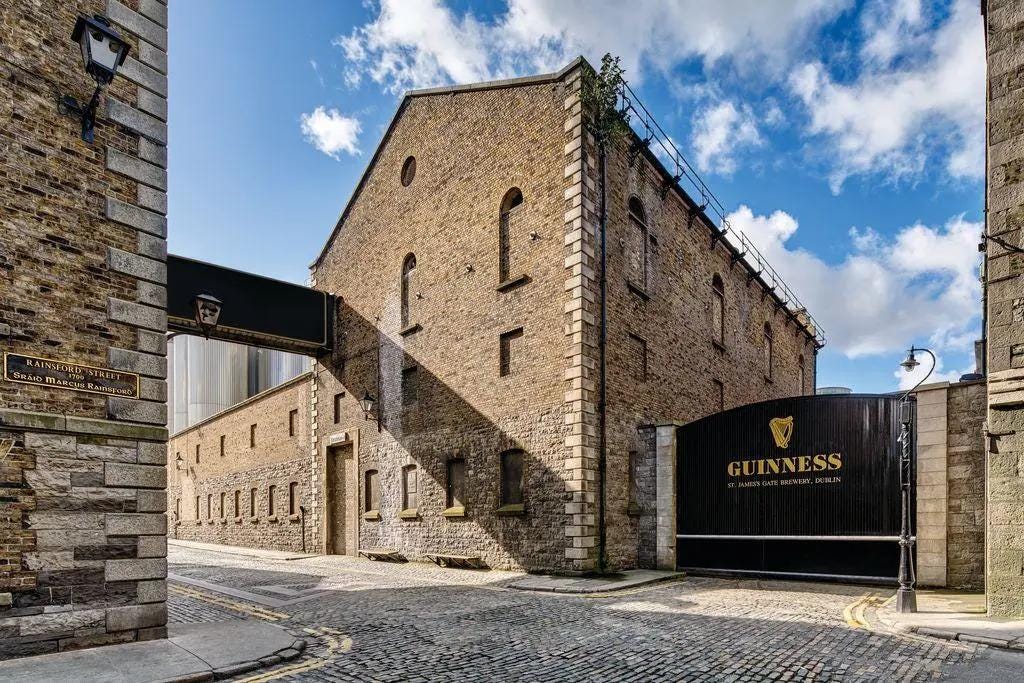
You see the same thing in banks, railway stations, department stores, warehouses, and company headquarters from the period. The nineteenth century was building an industrial civilization, and it wanted that civilization to look important.
When Titus Salt opened Salts Mill in 1853, the Illustrated London News described the building as if it were a civic monument rather than a mere works:
The great building of Saltaire itself is of light-coloured stone, in the Italian style of architecture. The south front of the mill—which is 545 feet in length (exactly that of St. Paul’s), and 72 feet above the level of the rails—has a very commanding and beautiful appearance. It is six stories high. The engine-houses are situated in the centre of the buildings, on either side of the principal entrance. The four first floors are thus divided; but the top room, which runs the whole length of the building, is one of the largest and longest (if not the very longest) in the world. The floors are based upon arches of hollow brick, supported by long rows of highly-ornamented cast-iron columns and massive cast-iron beams. The roof is of iron, and the windows are large and formed of immense squares of plate glass.
That is not the language of a shed. It is the language of a palace of industry: measured against St Paul’s, praised for its “commanding and beautiful appearance,” and admired for ornamented iron as well as for capacity.
Salt’s biographer Rev. R. Balgarnie later made the intention even clearer. Earlier mills, he wrote, had been built with little thought for architecture. Saltaire was meant to be different:
Hitherto, manufactories had been built with little regard to such conditions, and as for the buildings themselves, there was a decided lack of architectural taste in them. But the manufactory now proposed was to be, externally, a symmetrical building, beautiful to look at, and, internally, complete with all the appliances that science and wealth could command.
Beauty was not an accident added after the machines were in place. It was part of the brief.
Factories Were Still Part of the City
There is another difference that may be even more important.
Many old factories were built inside cities.
Today we tend to push industrial buildings toward motorways, ring roads, ports, and enormous industrial estates, where buildings are separated from ordinary street life and primarily experienced from a car or truck.
A nineteenth-century factory could have a very different relationship with its surroundings.
Workers walked past it every morning. Houses might stand nearby. Shops and pubs grew up around it. Streets ran along its walls. The factory entrance opened directly onto the town.
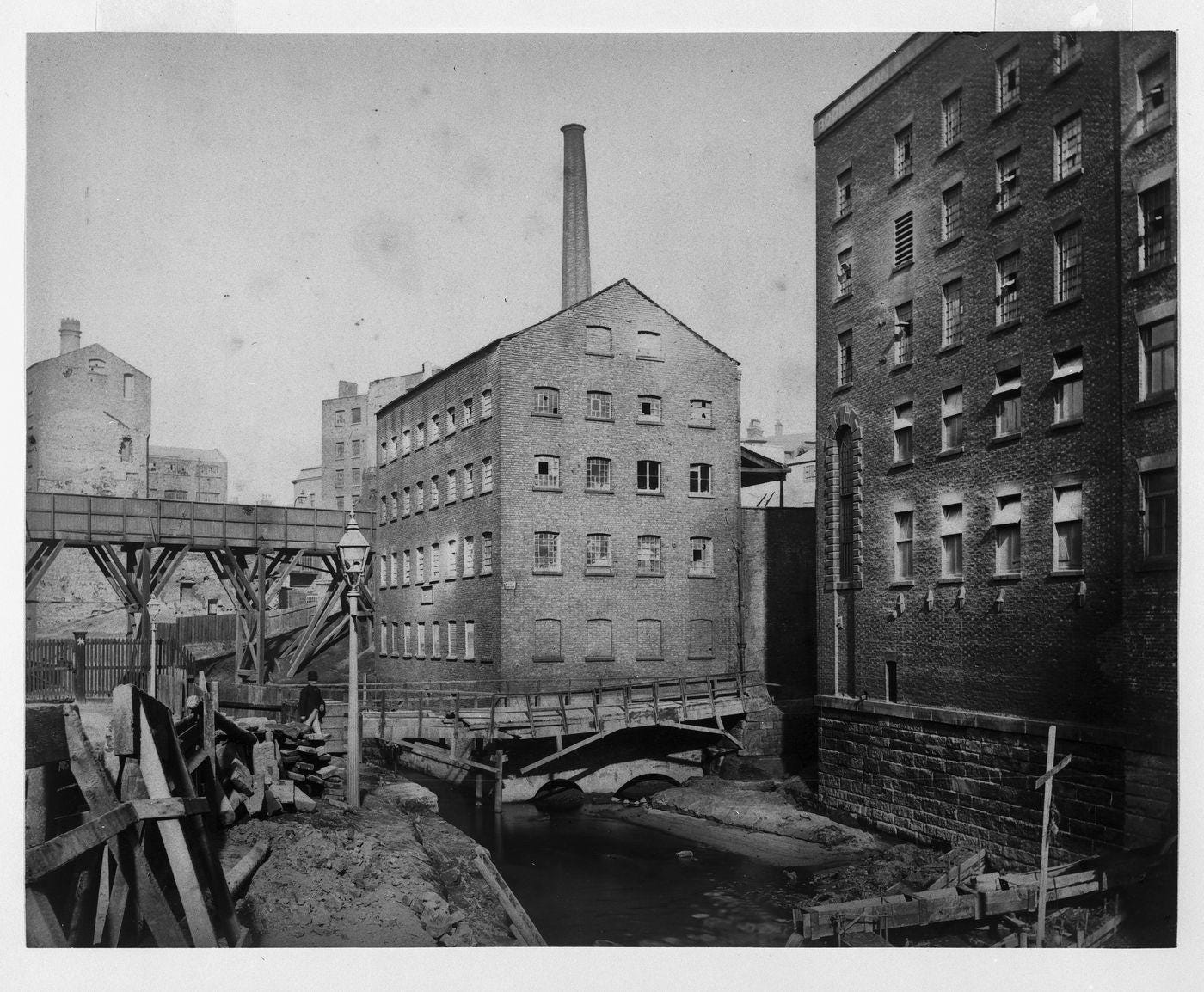
In places like Manchester, Leeds, Birmingham, Glasgow, Hamburg, and countless other industrial cities, factories, warehouses, workshops, houses, churches, railway buildings, and shops became part of the same urban fabric.
That changed what a factory façade meant.
If a building formed an entire side of a public street, its wall was also part of the street. Thousands of people might see it every day, which gave builders a reason to think about windows, entrances, materials, scale, and proportion.
The building had a job to do inside.
It also had a face outside.
This is something we largely abandoned when industry moved to the edge of the city.
Some Factory Owners Went Much Further
Of course, some industrialists were interested in considerably more than a handsome façade.
They built entire communities.
One of the most famous examples is Saltaire in Yorkshire, founded by the textile manufacturer Titus Salt during the nineteenth century. Salt moved his operations away from crowded Bradford and created a planned industrial settlement around Salts Mill, with housing for workers alongside schools, churches, shops, and other institutions.
Then there was New Lanark in Scotland, associated especially with Robert Owen, where industrial production became connected with experiments in worker housing, education, and social reform.
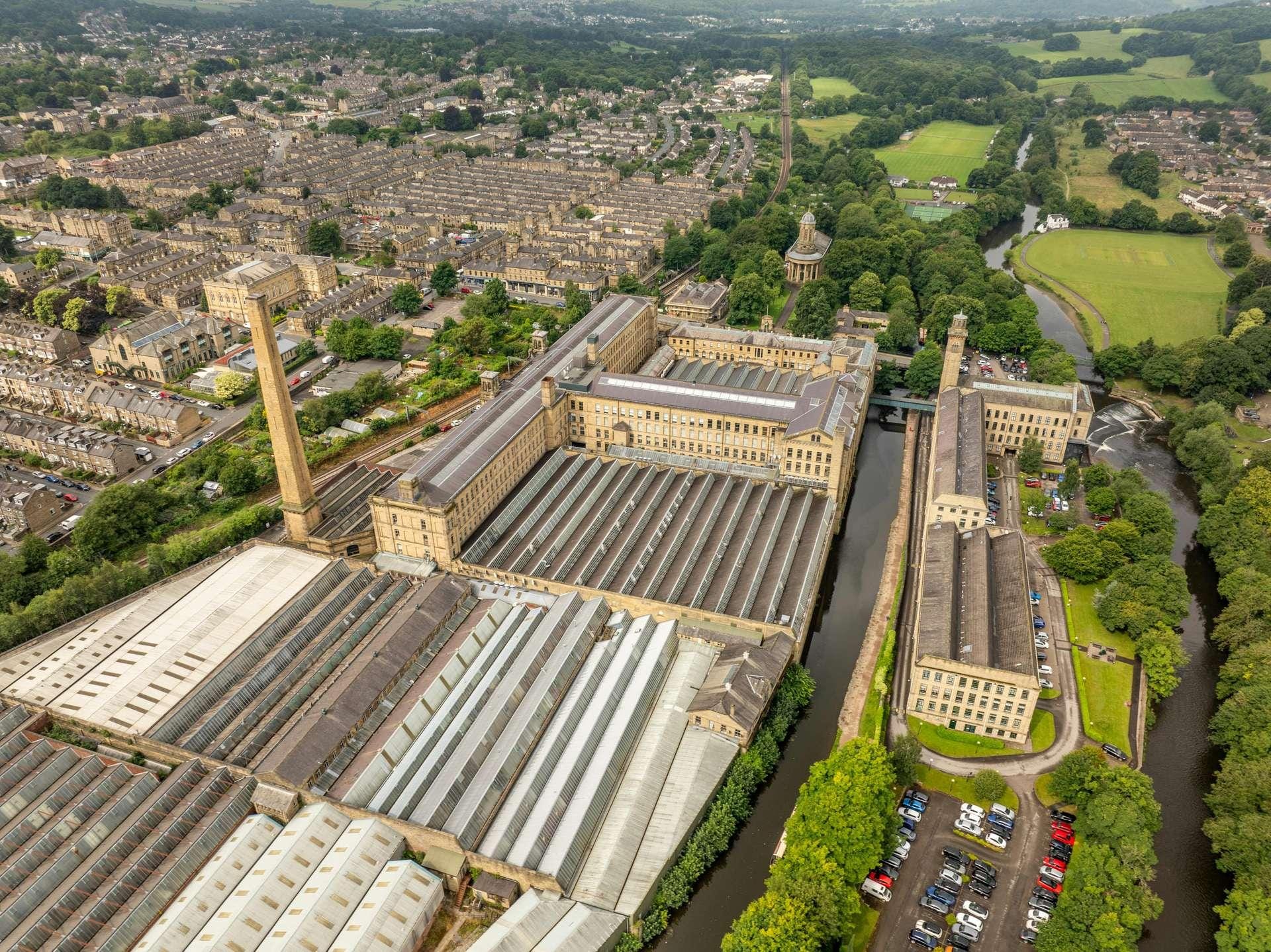
And perhaps the most extraordinary example came later at Bournville, where the Cadbury family developed a village around their chocolate works near Birmingham.
These places reflected a question that industrial Europe was increasingly forced to confront: if hundreds or thousands of people were going to spend their lives working around a factory, what kind of environment should surround them?
The answers varied enormously, and we should be careful about romanticizing industrial life. Nineteenth-century factory work could be exhausting and dangerous, industrial cities could be horrendously polluted, housing conditions were frequently appalling, and the beauty of a factory façade tells us very little about what conditions were like for the people working behind it.
Still, the architectural ambition is worth noticing.
Industrial buildings did not have to be treated as disposable boxes hidden from public view.
They could become part of a town.
William Morris, writing in 1884, pushed the idea further still. He thought factories were usually ugly because they expressed ugly work, not because workshops were doomed to ugliness:
Next, as to the buildings themselves I must ask leave to say something, because it is usually supposed that they must of necessity be ugly, and truly they are almost always at present mere night-mares; but it is, I must assert, by no means necessary that they should be ugly, nay, there would be no serious difficulty in making them beautiful, as every building might be which serves its purpose duly, which is built generously as regards material, and which is built with pleasure by the builders and designers; indeed, as things go, those nightmare buildings aforesaid sufficiently typify the work they are built for, and lack what they are, temples of overcrowding and adulteration and over-work, of unrest in a word; so it is not difficult to think of our factory buildings showing on their outsides what they are for, reasonable and light work, cheered at every step by hope and pleasure. So in brief, our buildings will be beautiful with their own beauty of simplicity as workshops, not bedizened with tomfoolery as some are now which do not any the more for that hide their repulsiveness; but moreover besides the mere workshops, our factory will have other buildings which may carry ornament further than that, will for it will need dining hall, library, school, places for study of various kinds, and other such structures; nor do I see why, if we have a mind for it, we should not emulate the monks and craftsmen of the middle ages in our ornamentation of such buildings, why we should be shabby in housing our rest and pleasure and our search for knowledge, as we may well be shabby in housing the shabby life we have to live now?
Morris was arguing against the factory system he knew. But he was also naming something the better Victorian mills already hinted at: a workshop can have “its own beauty of simplicity,” and a place of work need not be treated as unworthy of architecture.
If these essays have changed the way you see the world around you, the paid tier goes further.
You get longer, more researched pieces on the places that shaped Western civilization and the stories behind them. Deep dives into tradition, craftsmanship, and what the built world reveals about culture. Travel guides that teach you to actually read the places you visit.
This project is kept alive by people who care about old-world traditions. For a few dollars a month, you can be one of them.
The Germans Took This Even Further
By the late nineteenth and early twentieth centuries, architects were beginning to ask whether industrial architecture could develop an aesthetic of its own.
Germany produced some particularly interesting answers…