

A lot of people walk past astronomical clocks in old European cities, take a quick photo, maybe watch the figures move for a minute, and then continue on without thinking much about what they are actually looking at.
But once you stop and really consider it, astronomical clocks are among the most extraordinary creations in the history of civilization, because they are not simply clocks, but attempts to turn the universe itself into machinery.
That idea is far older than most people realize. Human beings have always been obsessed with time, but in the ancient world, time was never merely about convenience or punctuality. Time governed agriculture, religious festivals, navigation, prayer, seasonal rhythms, and the structure of life itself. Ancient Greek thinkers became especially fascinated by the heavens because they believed the cosmos was something ordered, mathematical, and intelligible.
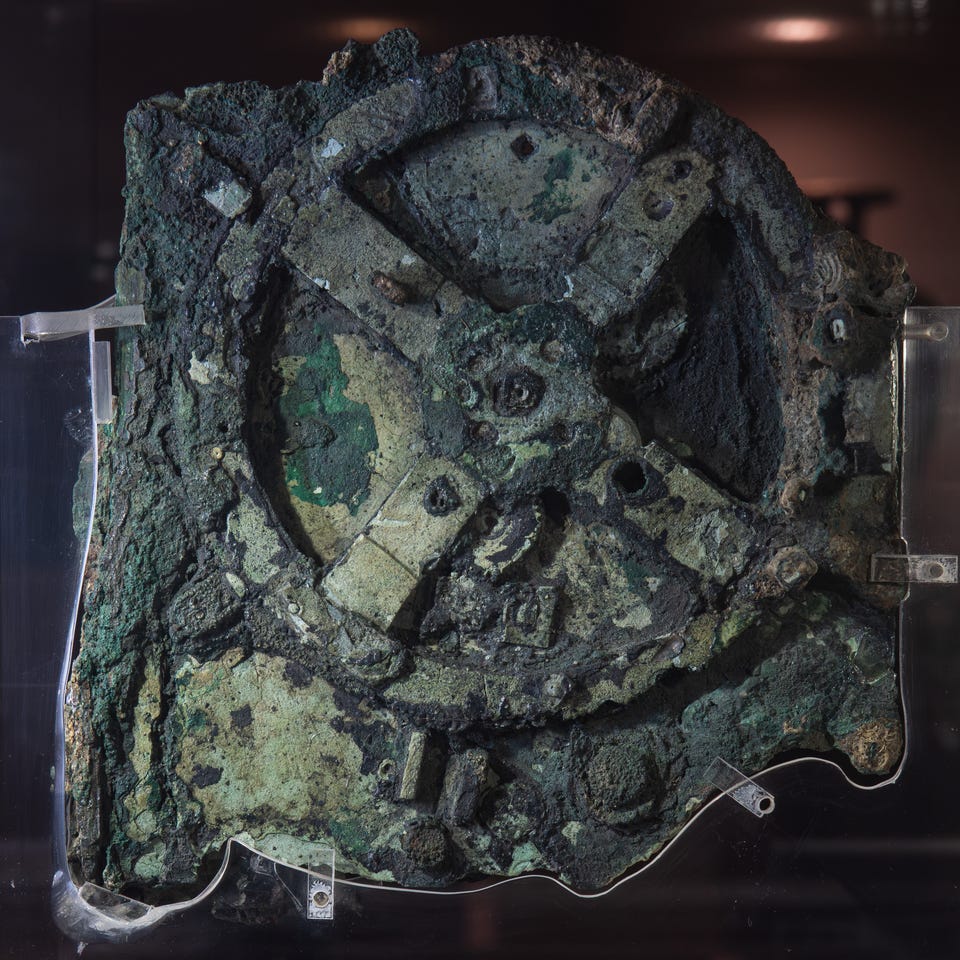
That belief produced one of the most astonishing ancient inventions ever discovered: the Antikythera mechanism, dating to roughly the second century BC. Found in a shipwreck off the Greek coast in 1901, this bronze device used an intricate system of precision gears to predict eclipses, lunar cycles, astronomical events, and likely planetary movement. More than two thousand years ago, someone had already attempted to build a mechanical model of the heavens.
And then, for centuries, that exact complexity largely disappeared from Europe.
The real flowering of astronomical clocks happened much later, in medieval Christian Europe, which surprises many modern people because they still imagine the Middle Ages as intellectually stagnant. The reality is the opposite.
Medieval Europe was obsessed with time, partly because life required it, but also because its entire worldview made time meaningful in a way modern life rarely does. Monastic life revolved around the canonical hours. Church bells regulated communities. Feast days structured the year. Agriculture depended on seasonal rhythms. But beneath all of that sat a much larger assumption: that creation itself reflected divine order.
Christian Europe inherited the ancient conviction that the universe possessed rational structure, but it placed that belief inside a theological framework. The heavens were not merely mathematical. They were created. Ordered. Meaningful.
And if the universe reflected divine intelligibility, then representing that order mechanically became one of the most ambitious intellectual projects imaginable.
1) The Ancient Dream of Mechanizing the Cosmos
The desire to understand celestial order goes back to the ancient world.
The Babylonians had already developed remarkably sophisticated astronomical observations centuries before Christ, carefully tracking eclipse cycles, planetary movement, and recurring celestial patterns with extraordinary accuracy. Greek thinkers inherited much of this astronomical knowledge and fused it with philosophy.
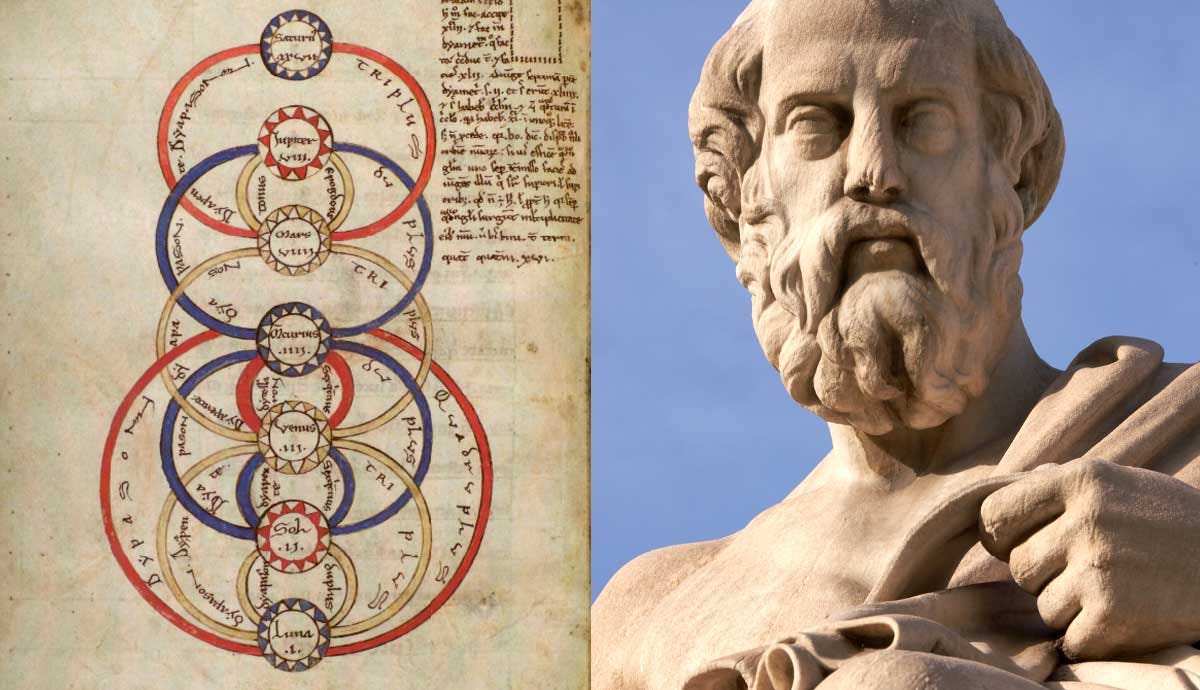
Plato’s Timaeus presents the cosmos as mathematically ordered and rationally intelligible. Aristotle built an elaborate cosmology of concentric heavenly spheres, imagining the universe as a structured hierarchy of celestial motion. Claudius Ptolemy, writing in second-century Alexandria, created the geocentric cosmological framework that would dominate educated thought for more than a thousand years.
But theory was only part of the story.
The truly astonishing leap came with the Antikythera mechanism, discovered in a Roman-era shipwreck near the Greek island of Antikythera. Dating somewhere between roughly 150 and 100 BC, this bronze machine contained dozens of interlocking gears designed to model astronomical cycles with extraordinary precision.
Researchers eventually realized this was essentially an ancient analog computer.
It predicted eclipses, tracked lunar phases, and likely modeled planetary movement according to Greek astronomical theory.
Someone in antiquity had already attempted to transform celestial order into precision machinery.
2) Why Medieval Christianity Became Obsessed with Time
When advanced mechanical timekeeping re-emerged, it did so in Christian Europe, and that was no accident.
Monasteries needed reliable schedules for prayer. The Benedictine Rule structured daily life around fixed liturgical hours. Cathedral life required coordination. Urban commerce increasingly demanded public timekeeping.
But practical need alone does not explain astronomical clocks.
Plenty of civilizations needed timekeeping. Very few built giant public cosmological machines.
The deeper explanation lies in medieval Christian cosmology.
Christian Europe inherited Greek assumptions about rational cosmic order, but now that order was understood explicitly as the work of a rational Creator. Thinkers like Augustine, Boethius, and later Thomas Aquinas all operated within a world where mathematics, harmony, proportion, theology, and cosmic structure belonged together.
Boethius matters especially here.
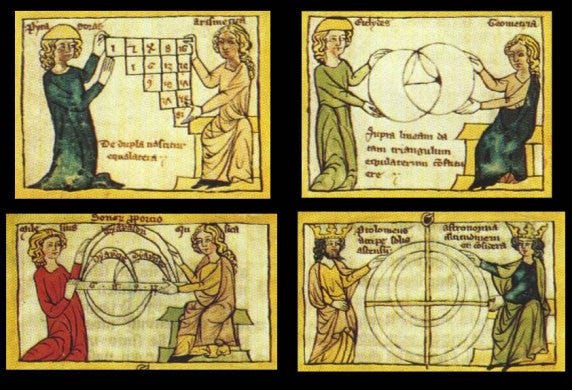
His writings on arithmetic, music, and cosmological order became foundational to medieval education. The quadrivium - arithmetic, geometry, music, and astronomy - was taught as interconnected ways of understanding reality itself.
That intellectual culture made astronomical clocks possible.
3) The Men Who Built the Universe in Brass
The real breakthrough came in the thirteenth and fourteenth centuries, when European engineers began building machines unlike anything seen for centuries.
One of the great pioneers was Richard of Wallingford, a name most people have never heard despite his extraordinary achievements.
Born around 1292, Richard became abbot of St Albans in England and also happened to be a mathematician, astronomer, and engineer of remarkable brilliance.
Around the 1320s and 1330s, he designed one of the most sophisticated astronomical clocks in medieval Europe.
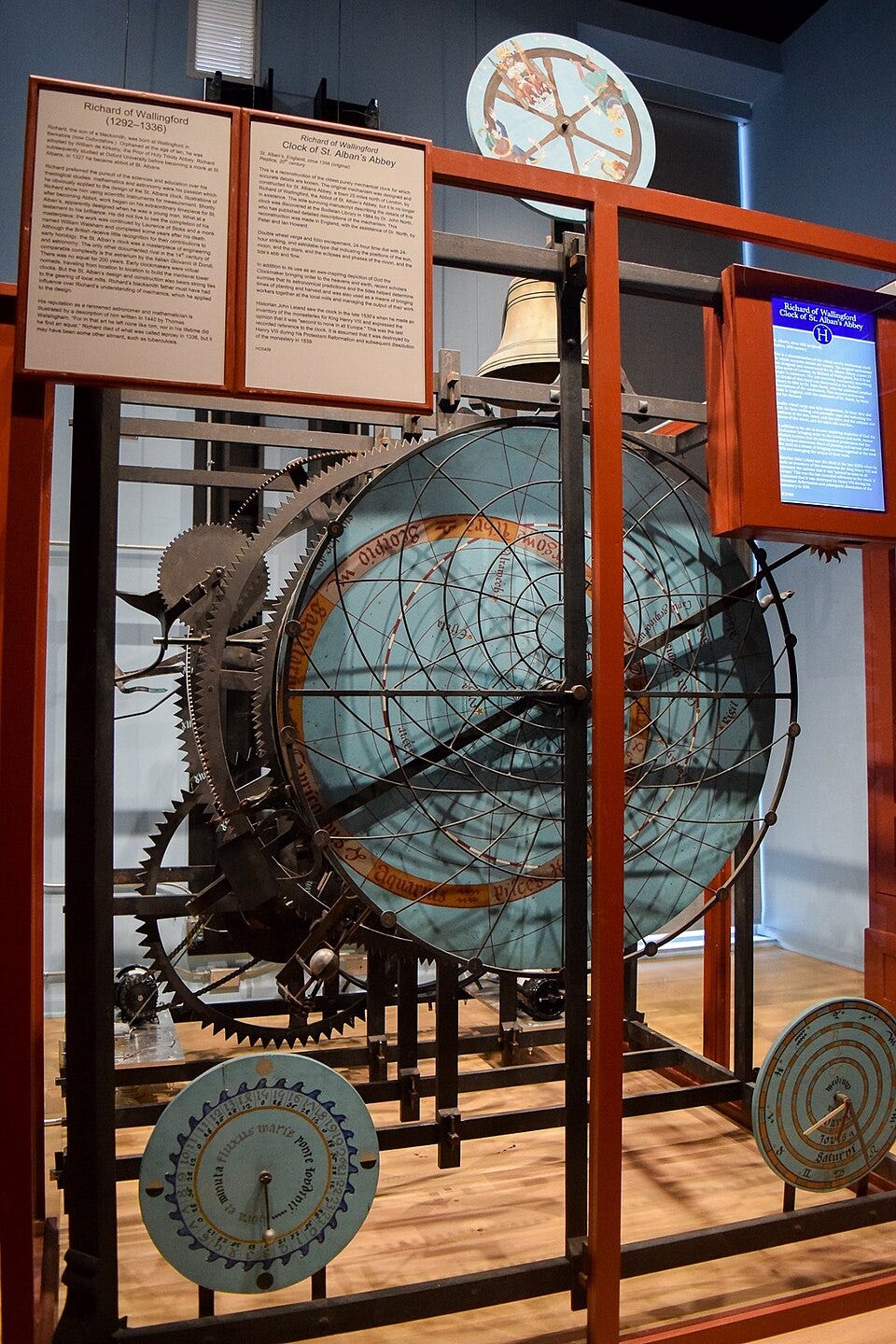
His clock reportedly tracked ordinary time, lunar phases, solar movement, tides, feast days, and complex celestial cycles.
That should permanently complicate the caricature of medieval monasteries as intellectually stagnant places.
Then came Giovanni de Dondi.
Born in Padua around 1318, he was a physician, astronomer, and engineer who completed the Astrarium around 1364, one of the most astonishing mechanical devices of the medieval world.
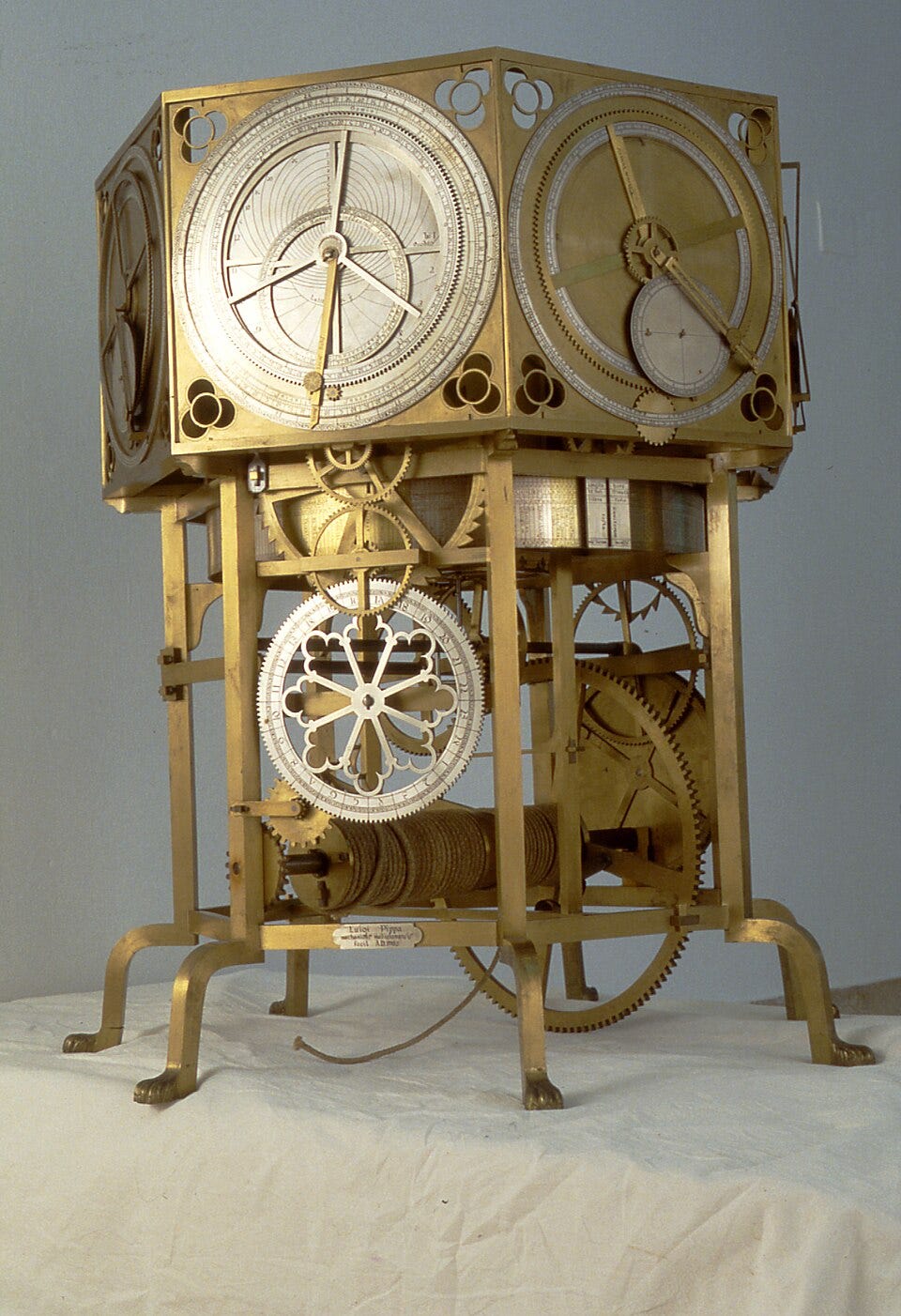
The Astrarium modeled the movement of the sun, moon, Mercury, Venus, Mars, Jupiter, and Saturn according to the Ptolemaic cosmological system.
The machine reportedly contained over one hundred moving parts.
No electricity.
No industrial manufacturing.
No modern engineering tools.
Just medieval craftsmanship, mathematics, and astonishing ambition.
4) Prague and the Public Theater of Time
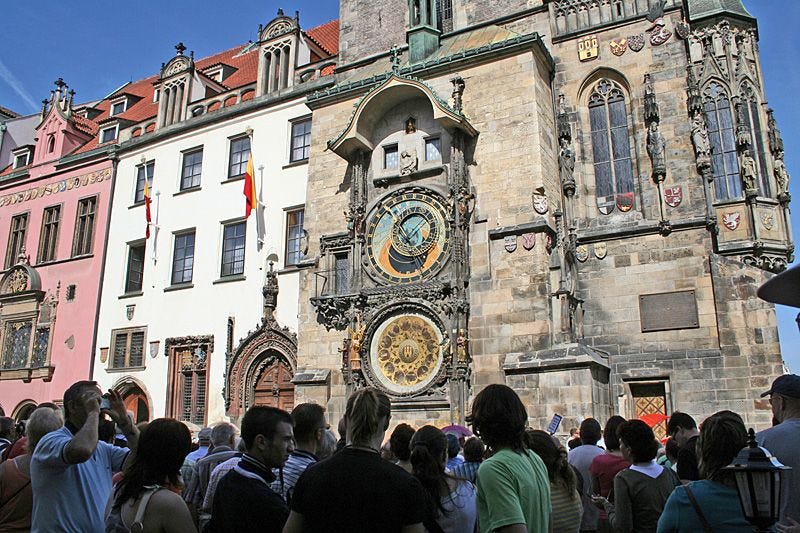
The most famous surviving astronomical clock is the Prague Astronomical Clock, installed in 1410, and even after everything that came before it, it still feels absurdly ambitious.
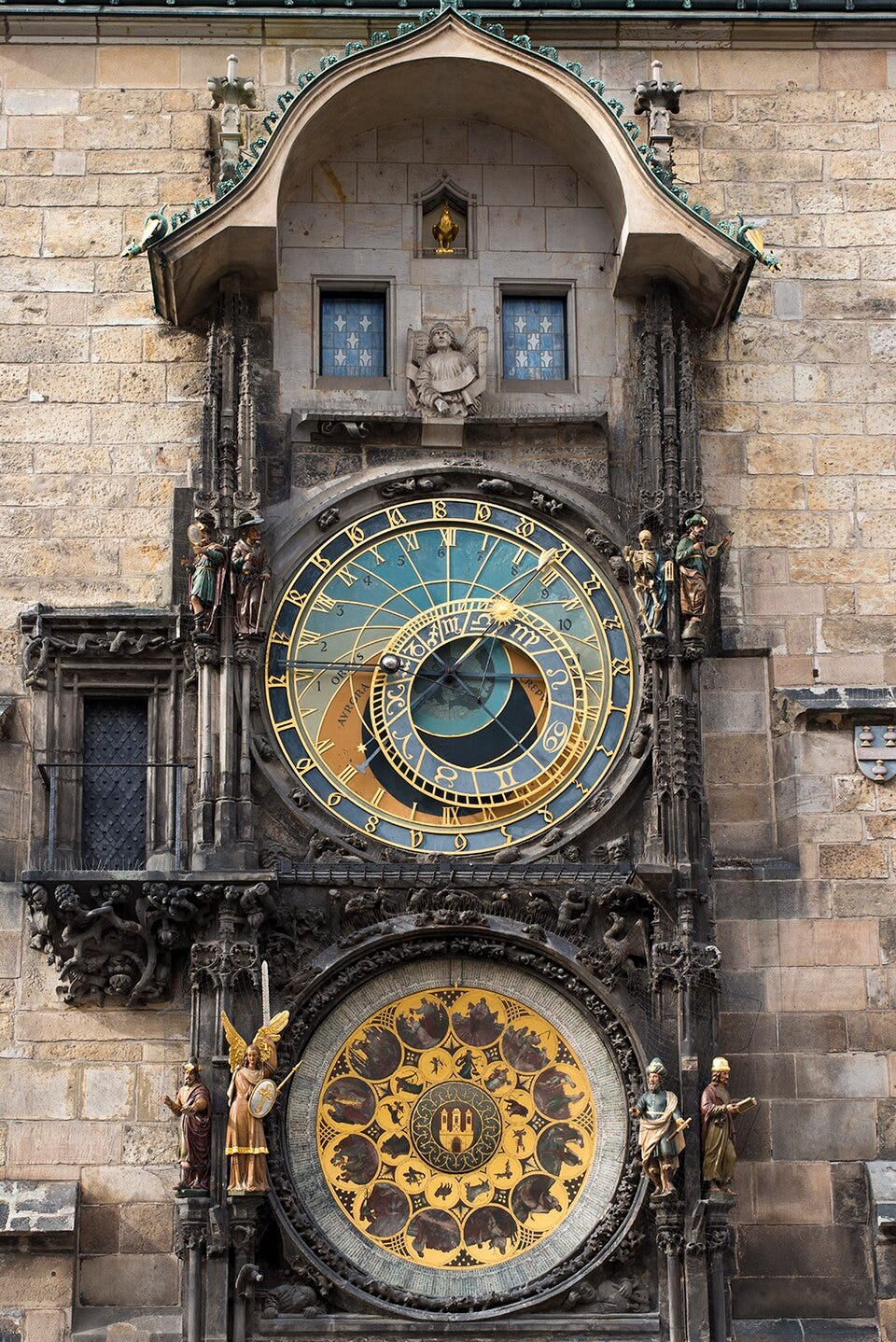
Built by the clockmaker Mikuláš of Kadaň in collaboration with Jan Šindel, an astronomer and mathematician associated with Charles University, the Prague clock was not simply built to tell time for local citizens.
The clock tracks ordinary time, Old Czech time, Babylonian time, sidereal time, the movement of the sun, the phases of the moon, and zodiac positions, all integrated into a stunning public monument.
ATTENTION: If these essays have changed the way you see architecture, consider becoming a paid subscriber.
For a few dollars a month, you get:
-In-depth pieces on architectural history, forgotten cities, and the civilizations that built them
-Essays on tradition, craftsmanship, and what the built world reveals about culture
-Travel guides that teach you how to actually read the places you visit
This project is kept alive by people who care about old-world traditions.
5) Strasbourg and the Cathedral Machine
If Prague is the most famous astronomical clock, the astronomical clock inside Strasbourg Cathedral may be the most intellectually overwhelming.
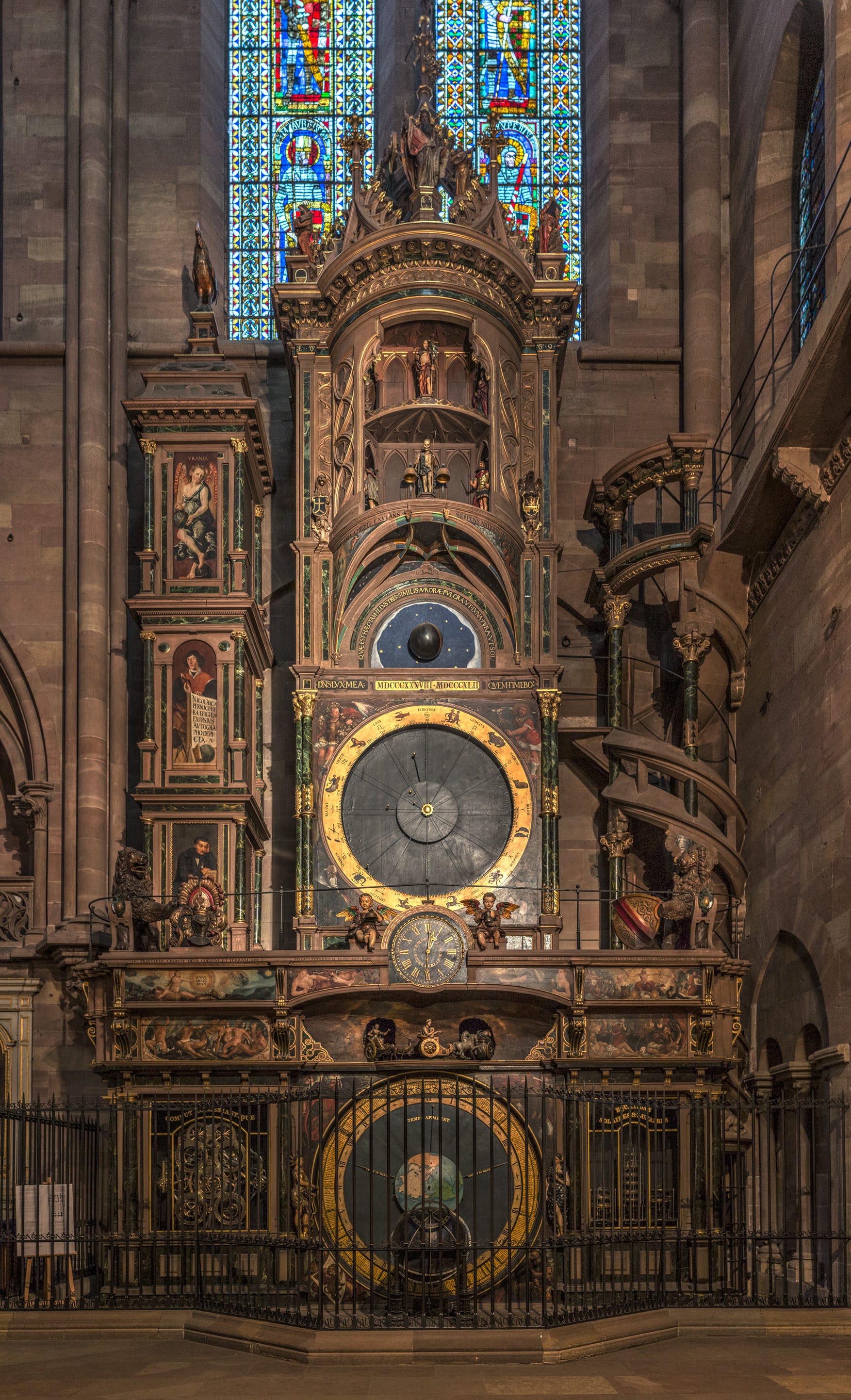
The current version dates largely to the nineteenth century, but it belongs to a much older tradition, because Strasbourg housed earlier astronomical clocks in the fourteenth and sixteenth centuries.
The Strasbourg clock tracks planetary movement, ecclesiastical calendars, perpetual calendars, feast days, lunar cycles, and astonishing astronomical calculations.
And because it sits inside a cathedral, the symbolism becomes impossible to miss.
The entire structure feels less like a machine and more like a sermon built out of gears.
It perfectly captures the medieval and early modern conviction that science, mathematics, theology, and beauty belonged together.
6) Lund Cathedral and the Northern Expansion of Cosmic Time
One of the most beautiful surviving astronomical clocks stands in Lund Cathedral in Sweden, and its existence tells you how far this intellectual culture spread.
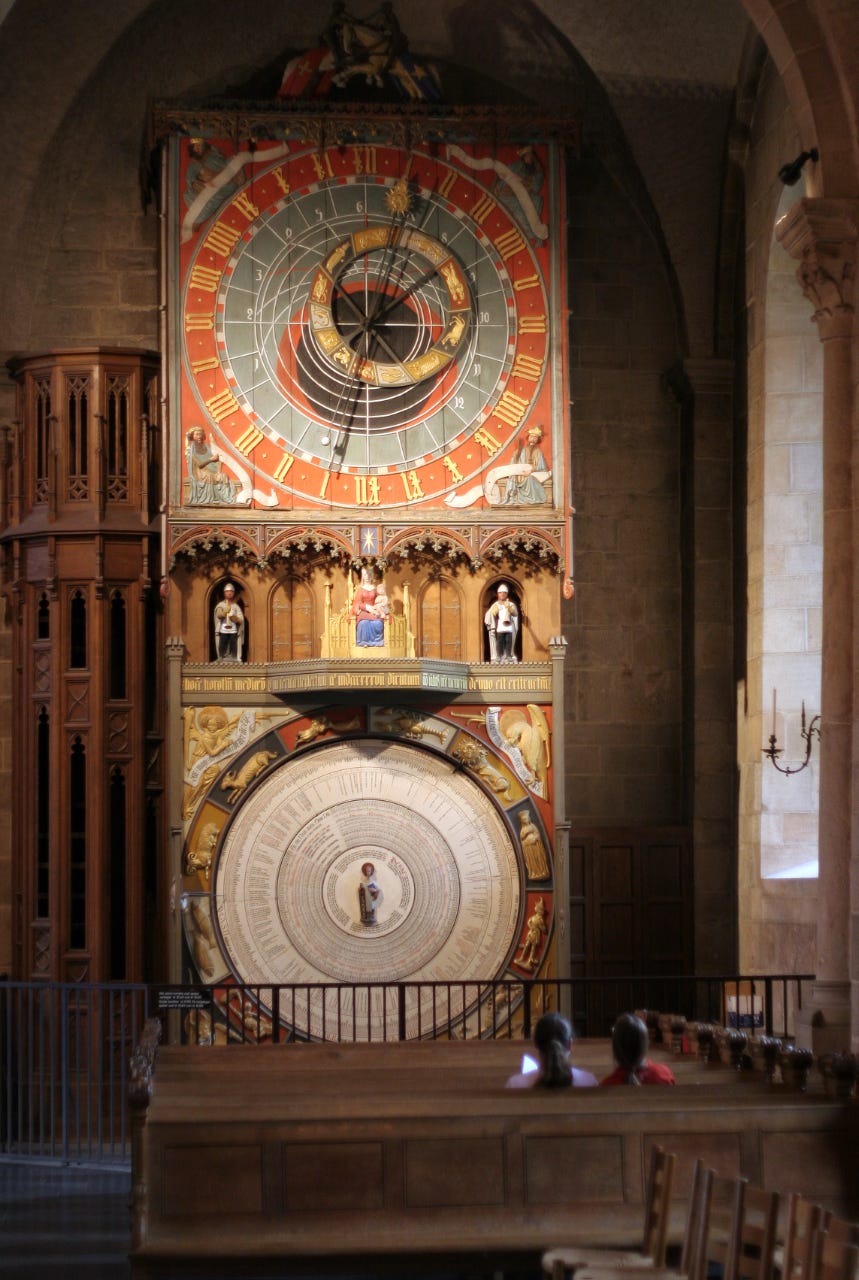
The Horologium Mirabile Lundense, likely dating to the fifteenth century, shows that this was not merely a southern European or imperial phenomenon.
Even in Scandinavia, Christian Europe had embraced this extraordinary synthesis of astronomy, craftsmanship, theology, and public symbolism.
The Lund clock tracks astronomical movement, lunar phases, liturgical time, and calendar cycles while incorporating elaborate symbolic mechanical displays.
Again, the point was never simply utility.
Timekeeping was integrated into worship, sacred rhythm, and communal life.
This was a civilization that believed cosmic order and religious life belonged together.
7) Wells Cathedral and the English Mechanical Imagination
England produced one of the oldest surviving astronomical clocks in the world inside Wells Cathedral.
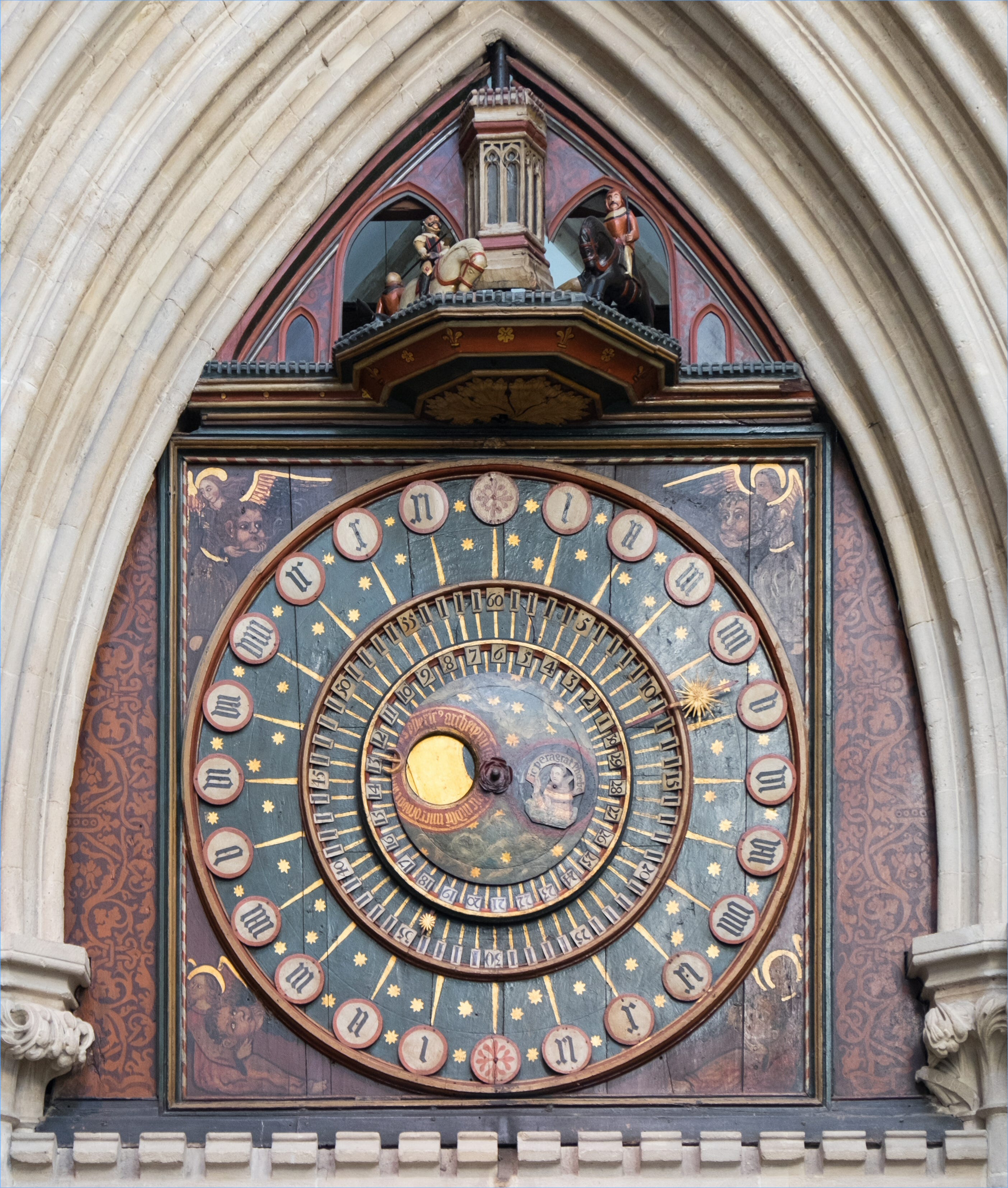
Dating to the late fourteenth century, likely around 1390, the Wells Cathedral clock remains one of the great treasures of medieval engineering.
What makes it fascinating is how distinctly medieval its worldview remains.
Its astronomical dial represents the geocentric universe, placing Earth at the center in accordance with medieval cosmology. It tracks the motion of celestial bodies while integrating symbolic religious imagery.
It was the best cosmological framework available at the time, rendered with extraordinary mechanical sophistication.
And again, notice where it sits. Inside a cathedral.
That tells you everything about how knowledge was understood.
8) The End of a Worldview
By the Renaissance and early modern period, astronomy began changing dramatically.
Copernicus published De revolutionibus in 1543.
Kepler transformed planetary astronomy in the early seventeenth century.
Galileo changed observation itself.
Clockmaking became increasingly practical, precise, and scientifically specialized.
But astronomical clocks survived.
These clocks came from a civilization that believed the universe was meaningful, mathematically intelligible, publicly beautiful, and worthy of contemplation.
That is why people still stand in front of them centuries later.
Because they instinctively recognize they are looking at something larger than machinery.
Great survey of these early mechanical marvels-I only recognized some of them. The best part: no computer necessary!
Big omission! Just as the knowledge of ancient Greeks came to Medeival Europe through the Islamic world, so did knowledge of the astrolabe and astronomical clocks:
"Astrolabes were further developed in the medieval Islamic world, where Muslim astronomers introduced angular scales to the design,[19] adding circles indicating azimuths on the horizon.[20] It was widely used throughout the Muslim world, chiefly as an aid to navigation and as a way of finding the Qibla, the direction of Mecca. Eighth-century mathematician Muhammad al-Fazari is the first person credited with building the astrolabe in the Islamic world.[21] The earliest Arabic treatise on astrolabes was composed sometime around 815 CE.[22]
The mathematical background was established by Muslim astronomer Albatenius in his treatise Kitab az-Zij (c. 920 ce), which was translated into Latin by Plato Tiburtinus (De Motu Stellarum). The earliest surviving astrolabe is dated AH 315 (927–928 ce). In the Islamic world, astrolabes were used to find the times of sunrise and the rising of fixed stars, to help schedule morning prayers (salat). In the 10th century, al-Sufi first described over 1,000 different uses of an astrolabe, in areas as diverse as astronomy, astrology, navigation, surveying, timekeeping, prayer, Salat, Qibla, etc.[23][24]
An Arab astrolabe from 1208
The spherical astrolabe was a variation of both the astrolabe and the armillary sphere, invented during the Middle Ages by astronomers and inventors in the Islamic world.[b] The earliest description of the spherical astrolabe dates to Al-Nayrizi (fl. 892–902). In the 12th century"
https://en.wikipedia.org/wiki/Astrolabe?wprov=sfla1