

Before we dive into today’s article, a quick reminder: you have less than 24 hours left to grab the discount.
I’m offering 30% off. This is the lowest price the subscription will ever be.
Instead of $9/month, you’ll pay just $6/month.
As a paid subscriber, you’ll unlock:
In-depth, thoroughly researched essays
Deep dives into tradition, craftsmanship, and culture
Curated travel guides and recommendations
My EVERLASTING gratitude
See you on the other side. 🫡
Visit Siena, Assisi, San Gimignano, Pienza, or Cortona and you begin to notice that their beauty comes from much more than individual buildings, because the streets, squares, churches, walls, towers, stairways, and surrounding countryside were conceived—or gradually evolved—as parts of the same place.
The hill itself determined where people could build, local stone determined what those buildings looked like, centuries of walking determined the scale of the streets, and the church or civic palace gave the town a center, which meant architecture grew out of the landscape rather than being placed on top of it.
And perhaps that is the first secret of the Italian hill town.
The Hill Came First
The Italians did not choose these difficult sites because climbing steep streets was particularly convenient, because many hill towns developed where elevation provided something far more important in the ancient and medieval worlds: defense.
A settlement on high ground could see approaching armies from miles away, while steep slopes, walls, gates, and towers made attacking considerably more difficult, so communities gathered on ridges and hilltops throughout central Italy and gradually adapted their buildings to terrain that refused to cooperate with straight lines.
That inconvenience eventually became one of their greatest architectural strengths.
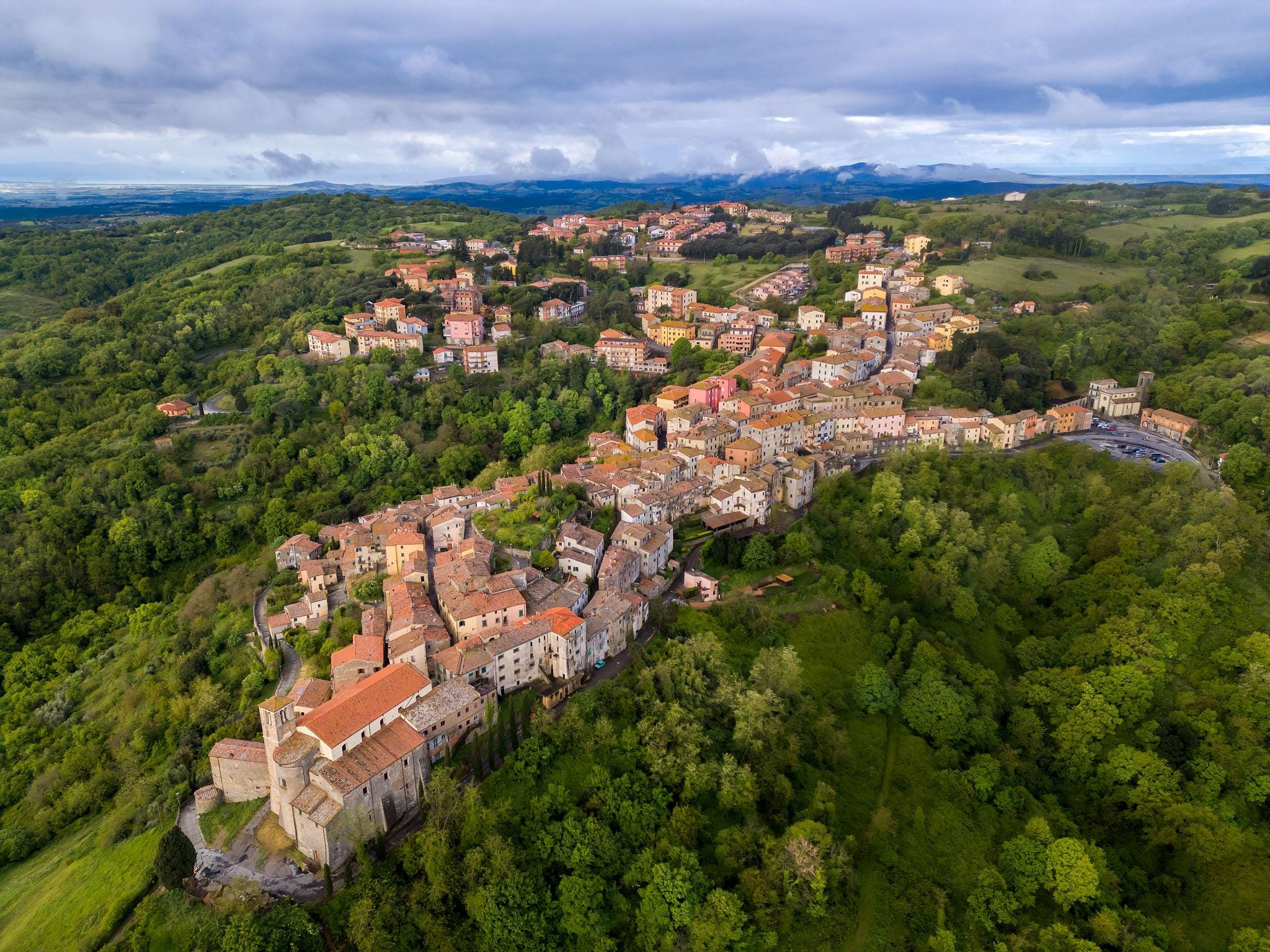
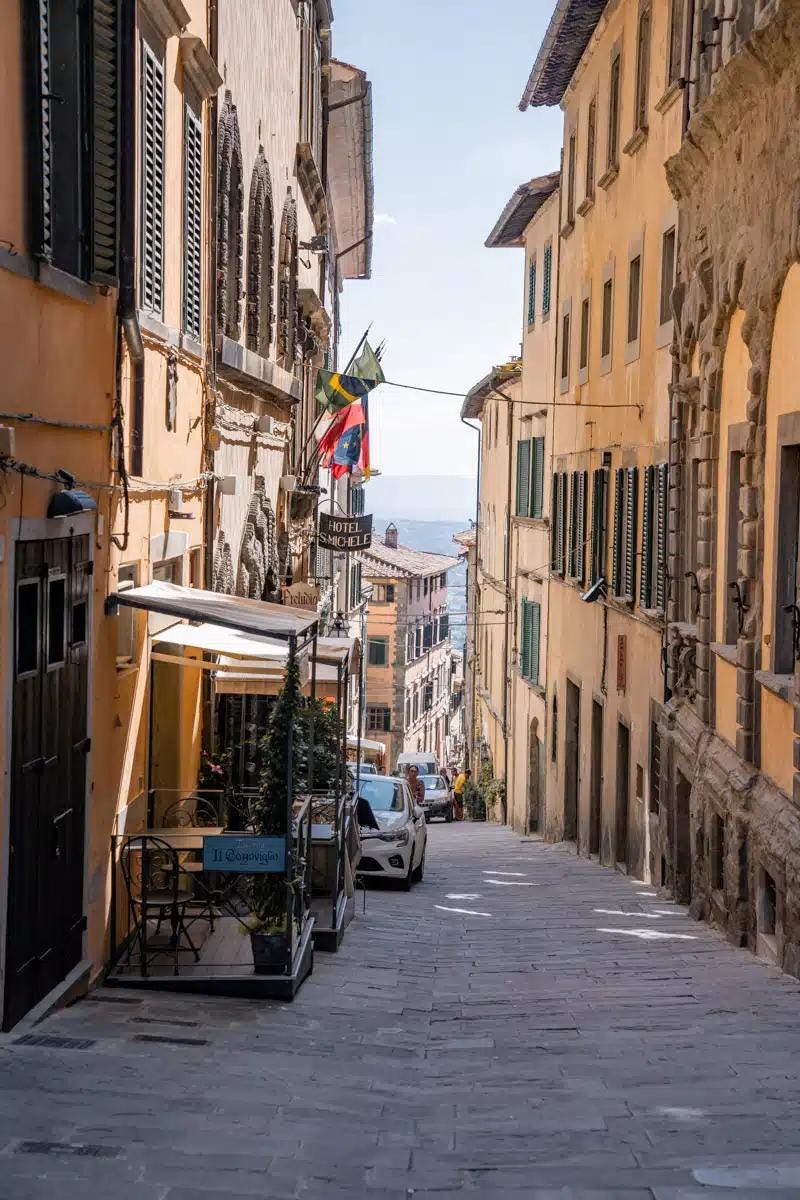
Instead of flattening the hill and imposing a rigid street grid upon it, builders worked with the contours already there, allowing roads to curve around slopes, stairways to climb between houses, retaining walls to hold back the earth, and buildings to rise at different levels depending upon where the ground happened to fall.
The result is a town that constantly changes as you move through it, because a street can begin wide and level before narrowing into an alley, passing beneath an arch, climbing a staircase, turning around a building, and suddenly opening onto a terrace overlooking miles of countryside.
You rarely see the entire town at once.
You discover it.
As Frank Lloyd Wright observed after living among the hills of Tuscany:
“No really Italian building seems ill at ease in Italy. All are happily content with what colour and ornament they carry, as naturally as the rocks and trees and garden slopes which are one with them. Wherever the cypresses rise, like the touch of a magician’s wand, it resolves all into a composition harmonious and complete.”
And of the deeper principle that a building must belong to its ground rather than sit upon it:
“It was unthinkable, at least unbreakable, that any home should be on that beloved hill. I knew that no house should be on a hill or on anything. It should be of the hill. Hill and house should live together, each the happier for the other […] and I began to build it as the brow of a hill.”
The Streets Were Built for Feet
The scale of these places makes much more sense once you remember that they developed around people walking rather than people driving, which meant a street only needed enough space for pedestrians, animals, carts, processions, merchants, and whatever traffic the town actually needed.
This produced streets narrow enough for the buildings on either side to remain constantly present, with windows above your head, doors opening directly onto the pavement, stone walls close enough to touch, balconies projecting overhead, and small architectural details remaining visible because you pass them from only a few feet away.
The narrowness also produces shade, something especially valuable beneath the Italian sun, while tall buildings and covered passages create cooler spaces where people can move through the town without spending the entire day exposed to direct sunlight.
Then there are the curves.
A winding medieval street continually conceals whatever lies ahead, which means the town reveals itself through a succession of small views rather than one enormous panorama, and this makes even a relatively small settlement feel incredibly rich because every corner offers another façade, staircase, shrine, archway, tower, or glimpse toward the countryside.
Assisi is wonderful for this.
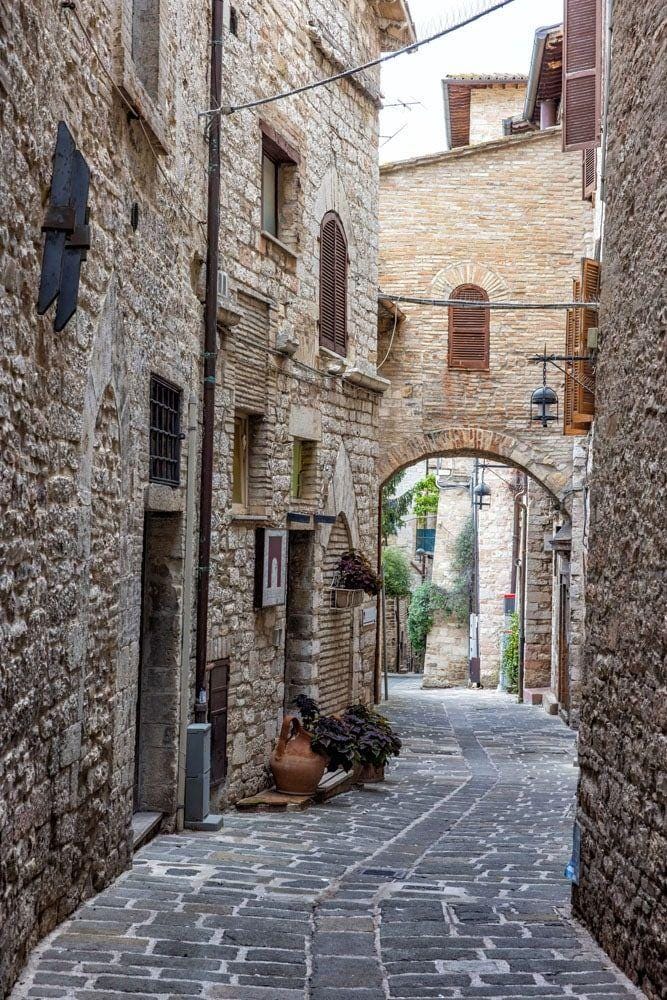
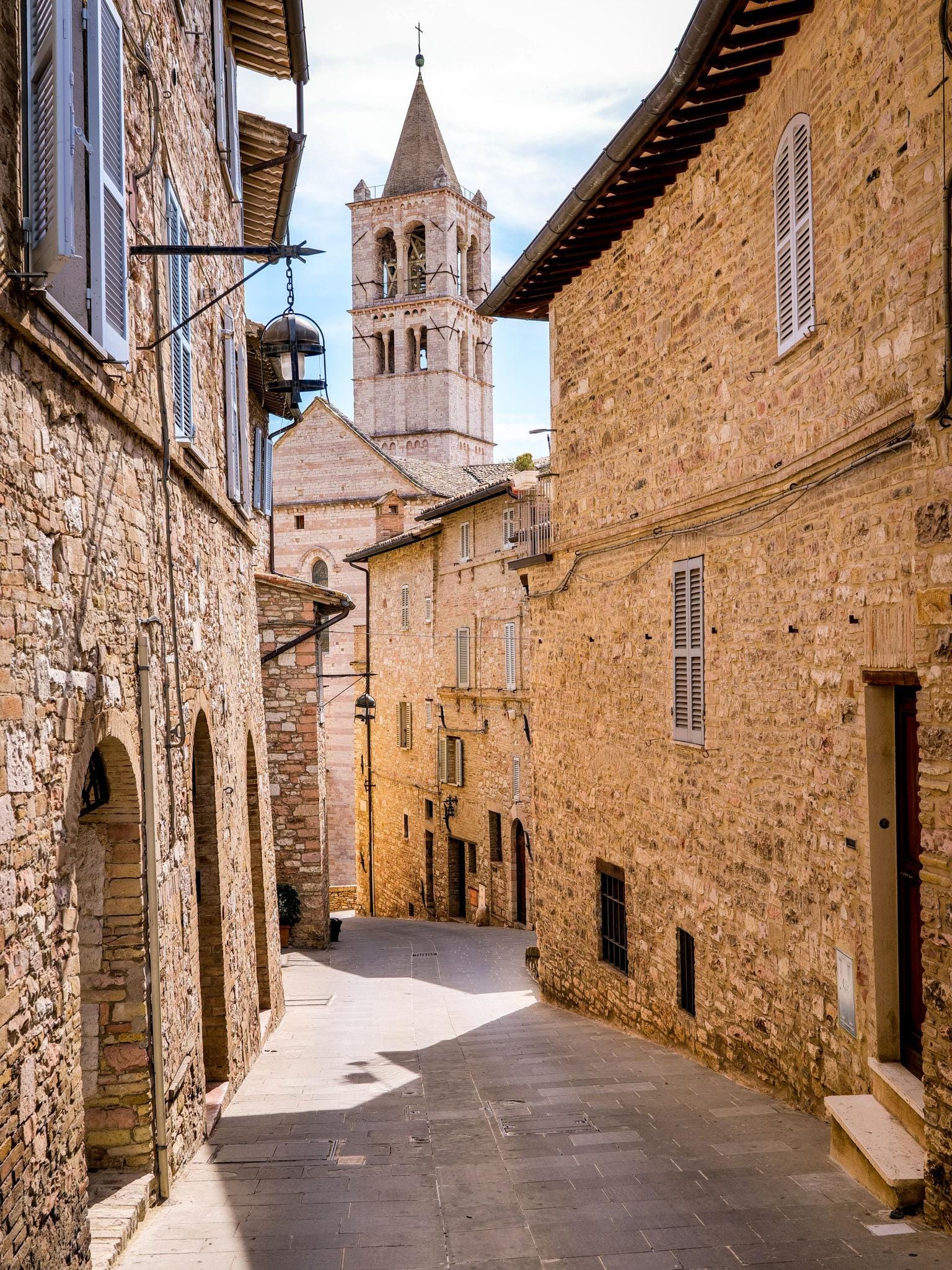
The streets climb and descend according to the slope of Mount Subasio, while pale stone buildings, arches, steps, small squares, churches, and distant views across Umbria continually alternate as you move through the town, giving the architecture a rhythm that could never emerge from a completely flat and standardized plan.
Leon Battista Alberti, writing in the mid-fifteenth century, already understood why such streets serve both beauty and practical life better than rigid geometry in a fortified or hillside settlement:
“When the road reaches a city, and that city is renowned and powerful, the streets are better straight and very wide, to add to its dignity and majesty. But with the settlement of a fortified town the entrances will be made safer if the road does not lead directly to the gate, but runs to the right or the left along the wall, and preferably even directly under the battlements. Within the town itself it is better if the roads are not straight, but meandering gently like a river flowing now here, now there, from one bank to the other. For apart from the fact that the longer the road seems, the greater the apparent size of the town, no doubt it will be of great benefit in terms of appearance and practical convenience, while catering to the requirements of changing circumstances. And it is no trifle that visitors at every step meet yet another façade, or that the entrance to and view from every house should face directly onto the street.”
The Buildings Came From the Land Around Them
Then there are the materials, because traditional Italian towns developed long before builders could order identical construction products from factories hundreds of miles away, so architecture naturally reflected whatever stone, brick, clay, timber, and plaster could be obtained in the surrounding region.
This is why different Italian towns possess such distinct personalities.
Assisi glows with pale pink and cream stone quarried around Mount Subasio, Tuscan towns are filled with warm stone, brick, stucco, and terracotta, while other regions developed architectural languages based upon completely different local materials.
These materials created harmony without requiring identical buildings, because a medieval house, Renaissance palace, church, workshop, and defensive tower could differ enormously in scale and purpose while still sharing the same stone, brick, roof tiles, and colors.
The town therefore acquired a natural palette.
Walls came from the surrounding geology, roof tiles came from local clay, streets were paved with stone, and the same weather gradually softened everything until buildings erected centuries apart began to look as though they belonged to one another.
If these essays have changed the way you see the world around you, the paid tier goes further.
You get longer, more researched pieces on the places that shaped western civilization and the stories behind them. Deep dives into tradition, craftsmanship, and what the built world reveals about culture. Travel guides that teach you to actually read the places you visit.
This project is kept alive by people who care about old world traditions. For a few dollars a month, you can be one of them.
San Gimignano Built Upward
Perhaps no Italian hill town demonstrates the power of the skyline better than San Gimignano, whose medieval towers still rise above the Tuscan countryside like the remains of a miniature medieval Manhattan.
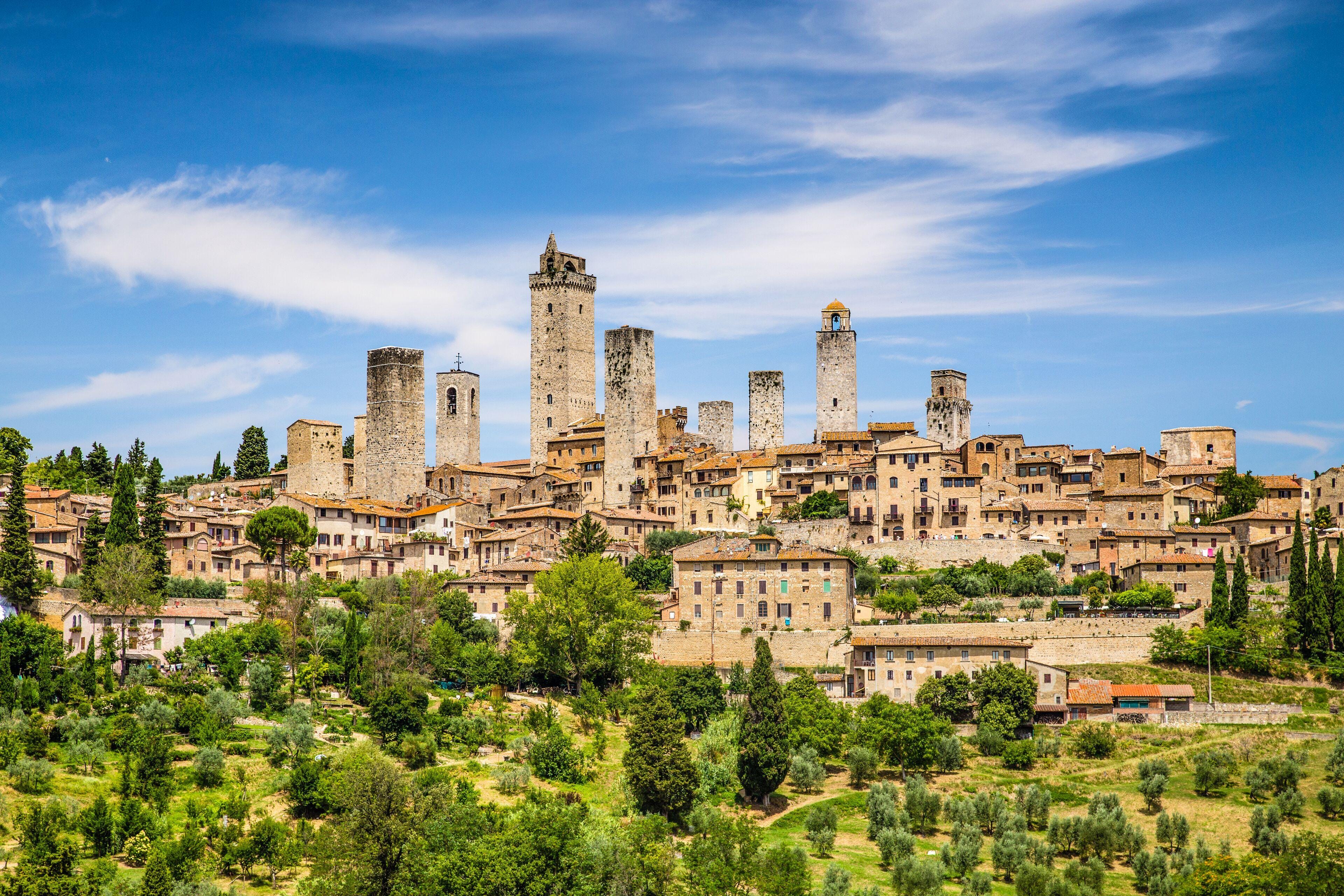
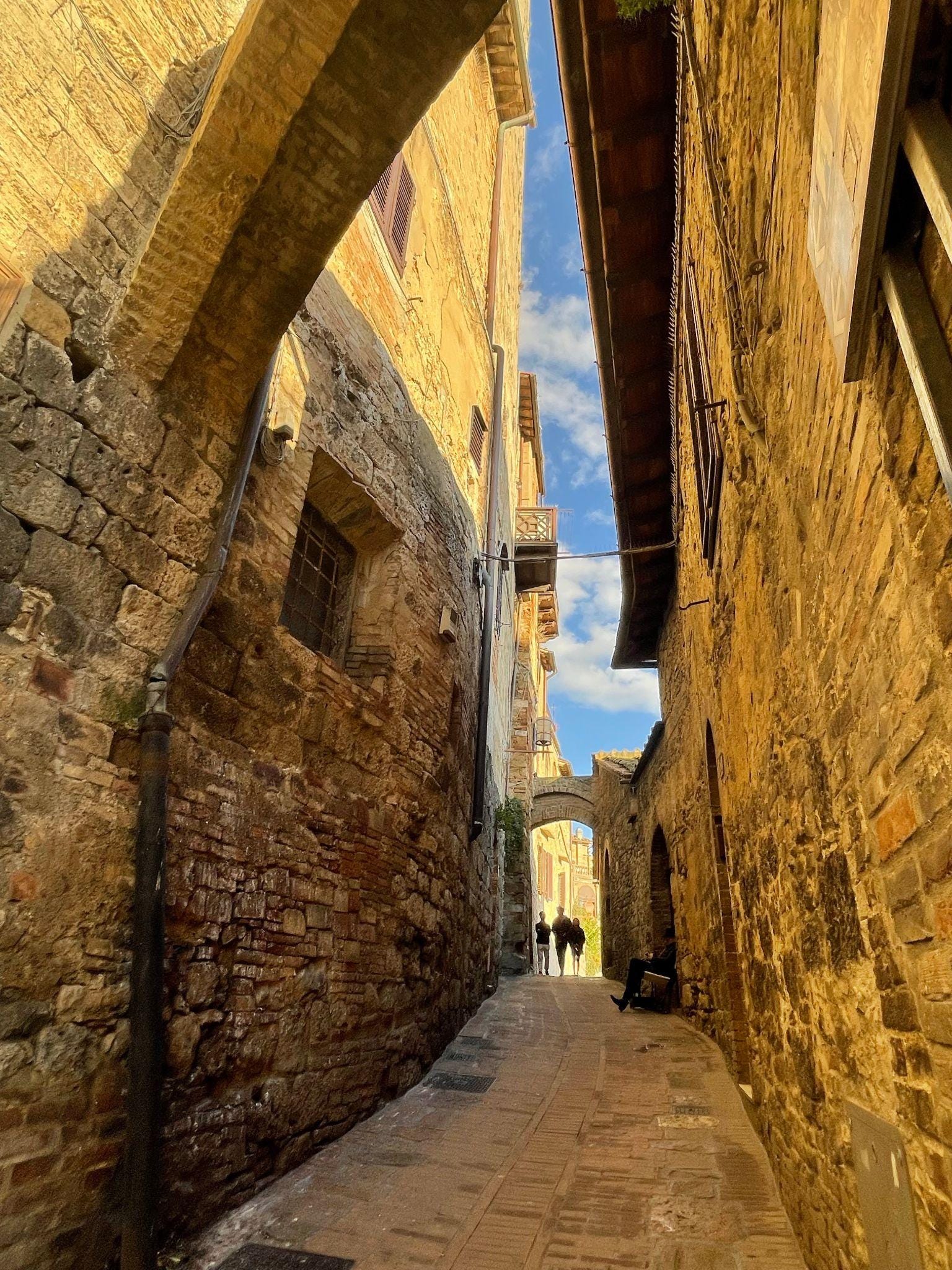
During the Middle Ages, wealthy families built towers that expressed status and provided defensive advantages during periods of factional conflict, and while dozens once crowded the town, fourteen survive today, giving San Gimignano one of the most recognizable silhouettes in Europe.
What makes the town so beautiful, however, is the way those towers participate in a larger hierarchy, because ordinary houses form the lower architectural fabric, palaces and churches provide larger masses, and towers rise above everything as landmarks that can be glimpsed from streets and squares throughout the settlement.
The skyline therefore tells you something about the town before you even enter it.
And once you pass through the walls, those same towers continually appear and disappear between buildings, helping you understand where you are while making the streets feel connected to something larger.
Everything Eventually Leads to the Piazza
The streets of the Italian hill town may twist and narrow, yet eventually many of them lead toward something larger.
The piazza.
This is where the genius of traditional Italian urbanism becomes especially clear, because the piazza is essentially an outdoor room created by the buildings surrounding it, with façades forming its walls, the sky becoming its ceiling, and churches, palaces, fountains, cafés, shops, and civic buildings giving people reasons to remain there.
The beauty comes partly from contrast.
After walking through a narrow street enclosed by tall buildings, suddenly entering a broad piazza feels dramatic because the sky opens above you, sunlight reaches the ground, important buildings become visible in their entirety, and the life of the town gathers into one place.
Few cities demonstrate this better than Siena.
Siena and the Piazza del Campo
The Piazza del Campo is one of Europe’s great public spaces, yet much of its beauty comes from something remarkably simple: the surrounding buildings work together.
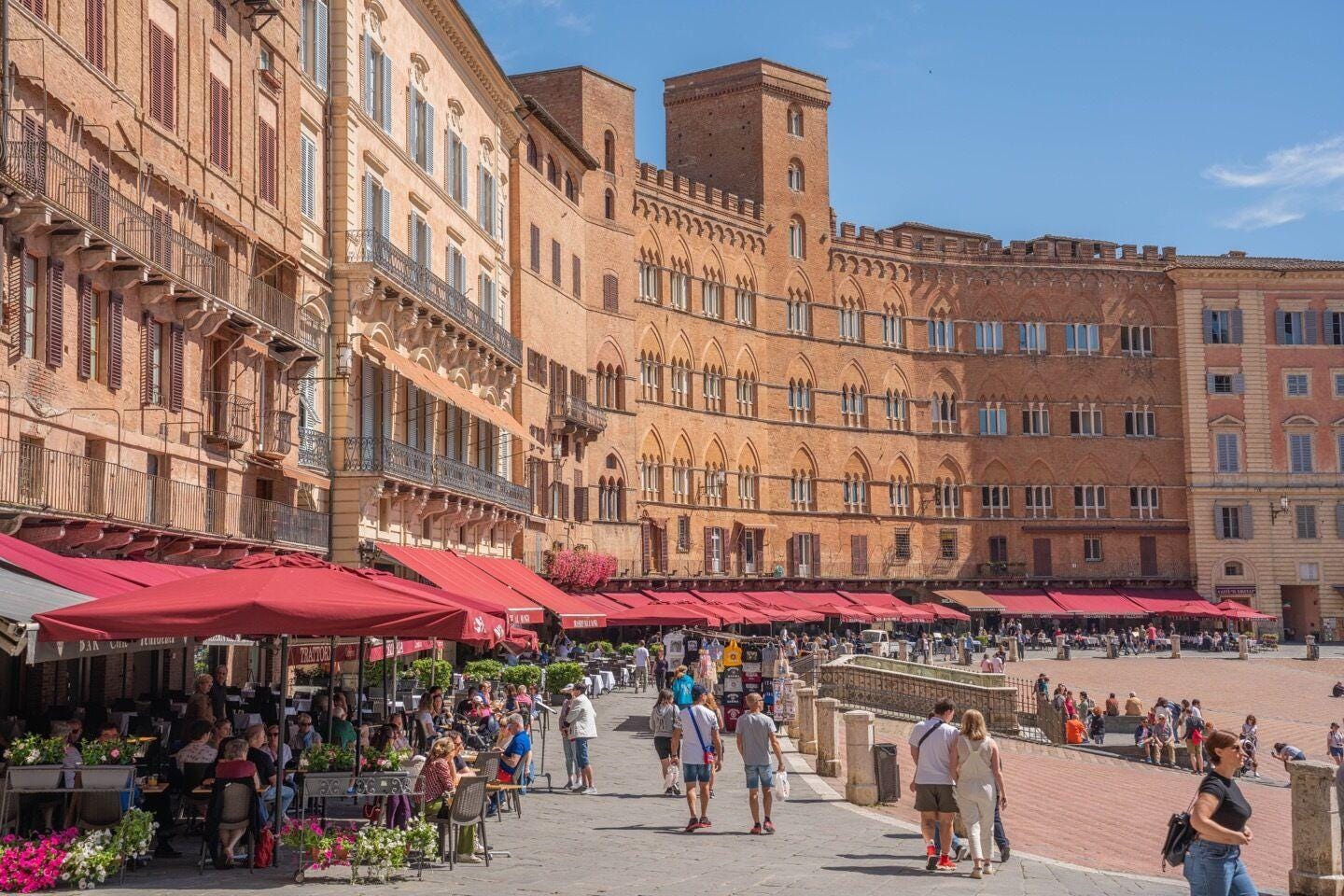
The piazza slopes gently toward the Palazzo Pubblico, while the Torre del Mangia rises dramatically above the surrounding roofs, giving the square a clear focal point without requiring every building around it to compete for attention.
The surrounding façades vary, yet their materials, proportions, windows, rooflines, and general scale allow them to form a continuous enclosure, while streets enter through relatively narrow openings that preserve the feeling of being inside a defined public room.
Then there is the extraordinary relationship between the square and everyday life, because the Campo was never simply a decorative plaza designed to be admired from a distance, but the civic heart of Siena, surrounded by government, commerce, festivals, meetings, celebrations, and the famous Palio horse race.
The architecture works because people give it life.
Camillo Sitte, who studied Italian public spaces more carefully than almost any other modern theorist, wrote:
“In the South of Europe, and especially in Italy, where ancient cities and ancient public customs have remained alive for ages, even to the present in some places, public squares still follow the type of the ancient forum. […] Public squares, or plazas, were then of prime necessity, for they were theaters for the principal scenes of public life, which today take place in enclosed halls. […] Before determining the question in a positive manner, we state the principle that during the Middle Ages and Renaissance public squares were often used for practical purposes, and that they formed an entirety with the buildings which enclosed them.”
The Church Belonged to the Skyline
Religion shaped these towns just as profoundly as commerce and defense, which is why churches occupy some of their most important sites and their towers, domes, and façades remain visible from across the surrounding countryside.
In Assisi, the Basilica of St. Francis stretches dramatically across the hillside, while in Siena the cathedral rises above the surrounding streets in striped marble, and throughout smaller towns the parish church or cathedral provides a spiritual and architectural center around which generations of buildings accumulated.
This created a hierarchy that traditional towns understood instinctively, because an ordinary house did not need to dominate the skyline when the church tower already did, while civic buildings could express their importance through greater height, richer materials, or prominent positions overlooking the piazza.
The important buildings therefore became landmarks, while ordinary buildings created the continuous fabric connecting them.
And because the streets were narrow, you rarely saw the entire church from far away inside the town, meaning its tower might appear first, followed by part of the façade, until another turn finally revealed the whole building across a piazza.
Architecture became something experienced in stages.
Pienza Shows What Happened When Someone Actually Planned It
Then there is Pienza, which makes the story especially interesting because unlike many Italian hill towns that developed gradually over centuries, its famous Renaissance center was deliberately transformed during the fifteenth century under Pope Pius II..