

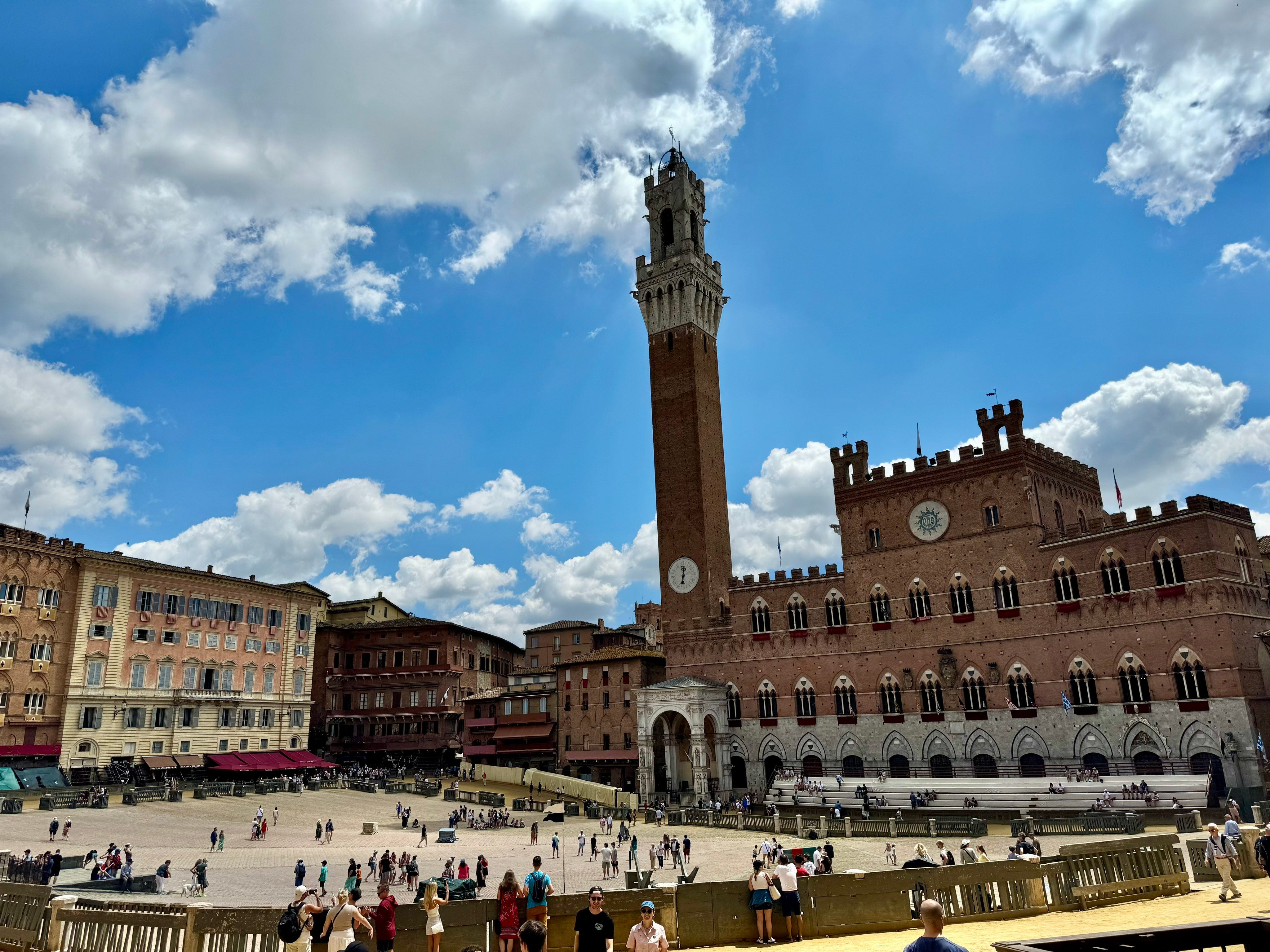
Walk into the Piazza del Campo in Siena and you will immediately understand why people fall in love with old European cities.
The square opens before you like an enormous outdoor room. Medieval buildings curve around its edges while the famous Torre del Mangia rises above the rooftops; people sit on the warm brick pavement and spend hours watching the life of the city unfold.
And the remarkable thing is that this place was built more than 700 years ago.
Now think about how many modern public squares have been built in the last fifty years. Cities spend millions on new plazas and hire famous architects to redesign their public spaces; yet how many of these places make you want to sit down and stay for an entire afternoon?
What did the medieval builders of Siena understand that so many modern architects seem to have forgotten?
The answer has surprisingly little to do with money or elaborate decoration.
For centuries European towns developed around public squares that served as the center of everyday life. These were places where merchants sold their goods and citizens gathered for important occasions; their architecture gradually developed around the simple idea that a public space should be both useful and beautiful.
And when you look closely at the most beloved squares in Europe you begin to notice that they share certain characteristics.
Here are seven rules that help explain why they work so well.
1. A Beautiful Square Needs Walls
The first thing you notice about many historic town squares is that they feel like rooms.
Of course there is no ceiling above them but the surrounding buildings create something remarkably similar to an interior. Their façades define the edges of the space while the entrances and windows give those edges a recognizable human character.
This is one of the reasons Piazza del Campo works so well.
The medieval buildings follow the curve of the square and create a continuous architectural boundary. Even though the surrounding houses differ in appearance they contribute to the same larger composition.
The square therefore feels like a place with a definite beginning and end.
Now imagine removing half the buildings around it.
Suddenly the space would lose much of its character because the buildings are doing more than providing a beautiful background. They are creating the square itself.
You can see the same principle in the Plaza Mayor in Madrid.
The square is surrounded by continuous façades with arcades running along the ground floor. Once you enter the space you immediately understand its boundaries and the surrounding architecture gives the enormous courtyard a sense of order.
This is why an open field with a fountain in the middle does not automatically become a beautiful square.
A town square needs buildings that give it shape.
The Greeks lay out their forums in the form of a square surrounded by very spacious double colonnades, adorn them with columns set rather closely together, and with entablatures of stone or marble, and construct walks above in the upper story. But in the cities of Italy the same method cannot be followed, for the reason that it is a custom handed down from our ancestors that gladiatorial shows should be given in the forum. Therefore let the intercolumniations round the show place be pretty wide; round about in the colonnades put the bankers’ offices; and have balconies on the upper floor properly arranged so as to be convenient, and to bring in some public revenue.
— Vitruvius, The Ten Books on Architecture, Book V, Chapter 1 (Morgan translation)
Vitruvius is already treating the forum as a walled outdoor room: colonnades for walls, offices and walks along the edge, and an open center held by architecture rather than left as a void.
2. The Proportions Must Feel Right
Once the surrounding buildings establish the boundaries another question becomes important.
How large should the square actually be?
A square can be too narrow and feel like an enlarged street. It can also be so enormous that the surrounding architecture loses its influence and the people crossing it appear almost insignificant.
Traditional European squares usually establish a recognizable relationship between their width and the height of the buildings around them.
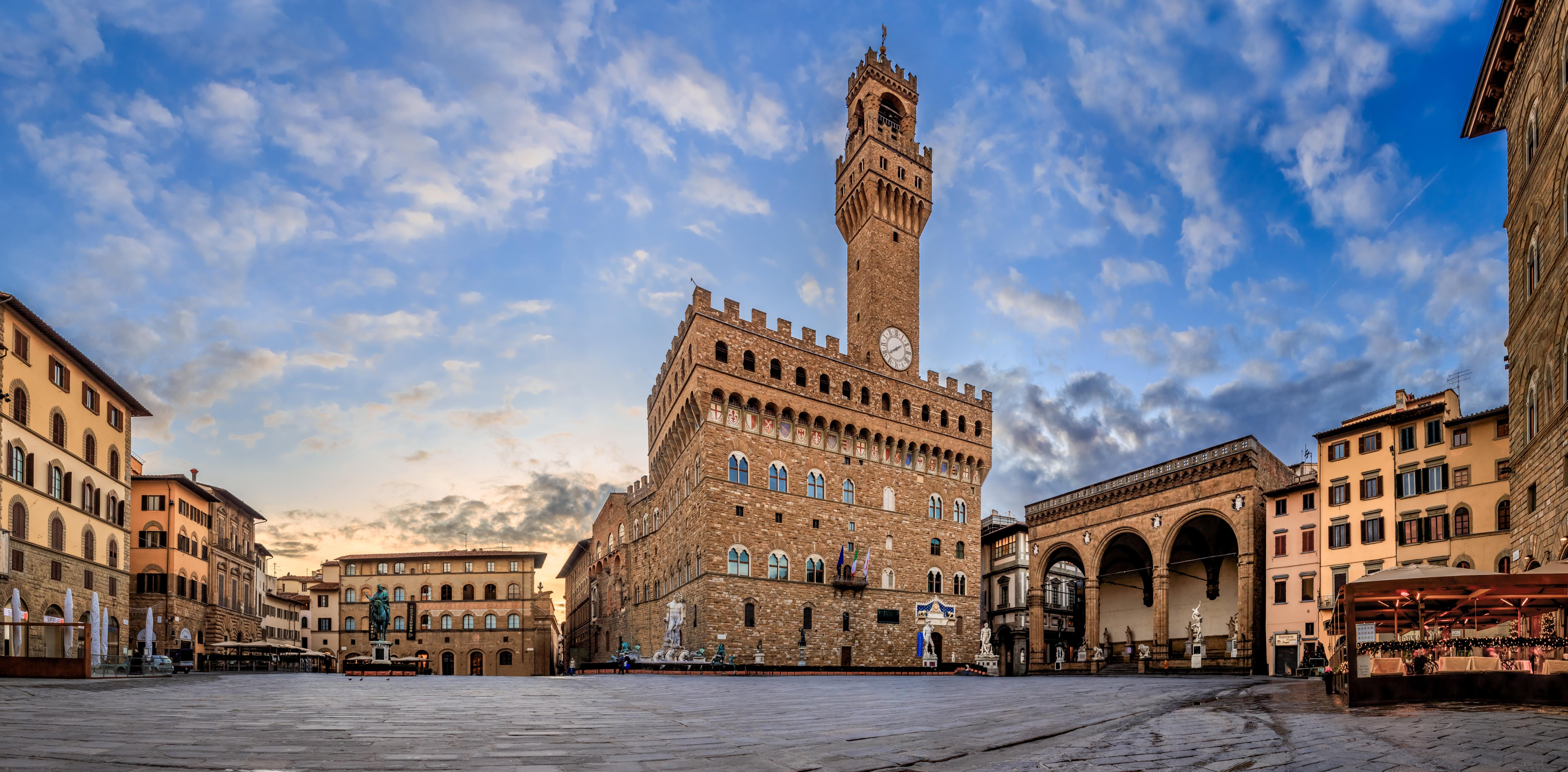
Consider the Piazza della Signoria in Florence.
The Palazzo Vecchio dominates one side of the square while the surrounding buildings help define the remaining edges. The space is large enough to accommodate public gatherings but the architecture remains close enough to give the visitor a sense of enclosure.
This relationship matters because people experience architecture from the ground.
When the surrounding buildings become too distant their details are difficult to appreciate. The windows and entrances disappear into the background and the square begins to feel like an empty expanse.
Older squares generally avoided this problem by growing within the dense fabric of the city.
The buildings stood close together and the public space developed at a scale that remained connected to everyday life.
Of course there is no single mathematical formula that produces a beautiful square.
But the best examples make the relationship between open space and surrounding buildings feel natural.
The size of a forum should be proportionate to the number of inhabitants, so that it may not be too small a space to be useful, nor look like a desert waste for lack of population. To determine its breadth, divide its length into three parts and assign two of them to the breadth. Its shape will then be oblong, and its ground plan conveniently suited to the conditions of shows. The columns of the upper tier should be one fourth smaller than those of the lower, because, for the purpose of bearing the load, what is below ought to be stronger than what is above, and also, because we ought to imitate nature as seen in the case of things growing; for example, in round smooth-stemmed trees, like the fir, cypress, and pine, every one of which is rather thick just above the roots and then, as it goes on increasing in height, tapers off naturally and symmetrically in growing up to the top.
— Vitruvius, The Ten Books on Architecture, Book V, Chapter 1
Two millennia before modern plazas were sized for traffic diagrams, Vitruvius tied the dimensions of the public square to the number of people who would actually use it, and warned against a space that looks deserted.
If these essays have changed the way you see the world around you, the paid tier goes further.
You get longer, more researched pieces on the places that shaped Western civilization and the stories behind them. Deep dives into tradition, craftsmanship, and what the built world reveals about culture. Travel guides that teach you to actually read the places you visit.
This project is kept alive by people who care about old-world traditions. For a few dollars a month, you can be one of them.
3. Every Square Needs Something Important to Look At
Walk into a beautiful historic square and your eyes usually find something that deserves attention.
It might be a church standing above the surrounding rooftops or a town hall with an impressive entrance. Sometimes a fountain occupies the center while the surrounding buildings provide a beautiful architectural setting.
The important thing is that the square possesses a clear focal point.
In Siena that role belongs to the Palazzo Pubblico.
Its great tower rises above the surrounding buildings while the square slopes toward the town hall. The entire composition seems to draw your attention in that direction.
This was particularly appropriate because the building served as the seat of the city’s government.
The architecture therefore expressed something about Siena’s political life.
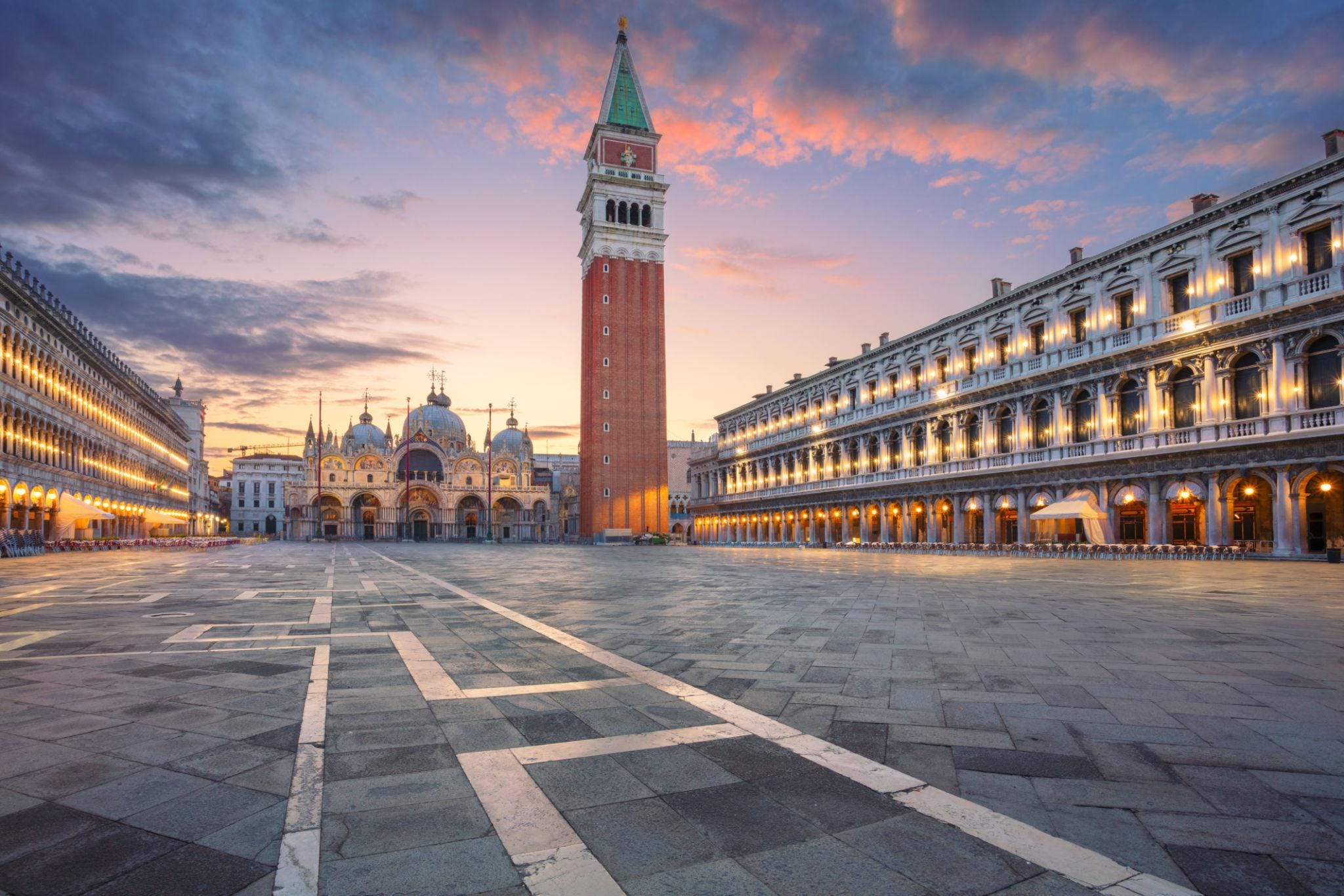
The Piazza San Marco in Venice offers another example.
St Mark’s Basilica provides an extraordinary focal point at one end of the square while the surrounding arcades establish a more regular architectural setting. The contrast between the basilica and the surrounding buildings makes the church appear even more remarkable.
And this brings us to an important principle.
A beautiful square does not require every building to compete for attention.
Sometimes the most successful arrangement allows one important building to dominate while the others create a harmonious background.
I will say that a sacred building ought to be the most beautiful and the most ornate of all, and that a public building ought to be more ornate than a private one. … The principal ornament of the city will be the public buildings, and among these the temples will hold the first place. … Let the temple be so placed that it may be seen from every side, and that its dignity may be increased by the space which surrounds it; and let the forum, the basilica, and the other public works be so disposed that each may have its proper view and its proper approach.
— Leon Battista Alberti, De re aedificatoria (paraphrased in the standard sense of Books VII–VIII; the civic hierarchy of temple, forum, and public buildings is Alberti’s own)
Alberti’s point is hierarchical, not decorative. One building is allowed to matter more than the others, and the square exists partly so that building can be seen.
4. The Buildings Must Belong Together
One of the most remarkable things about old European squares is that their buildings are rarely identical.
Different owners commissioned them at different times and their façades sometimes belong to different architectural periods. Yet the overall composition can still feel surprisingly harmonious.
How did they achieve this?
A large part of the answer lies in the way traditional buildings followed shared conventions.
Their windows might be arranged in similar patterns while the heights of neighboring buildings remained relatively consistent. Even when individual façades received different decorations the larger architectural rhythm continued across the square.
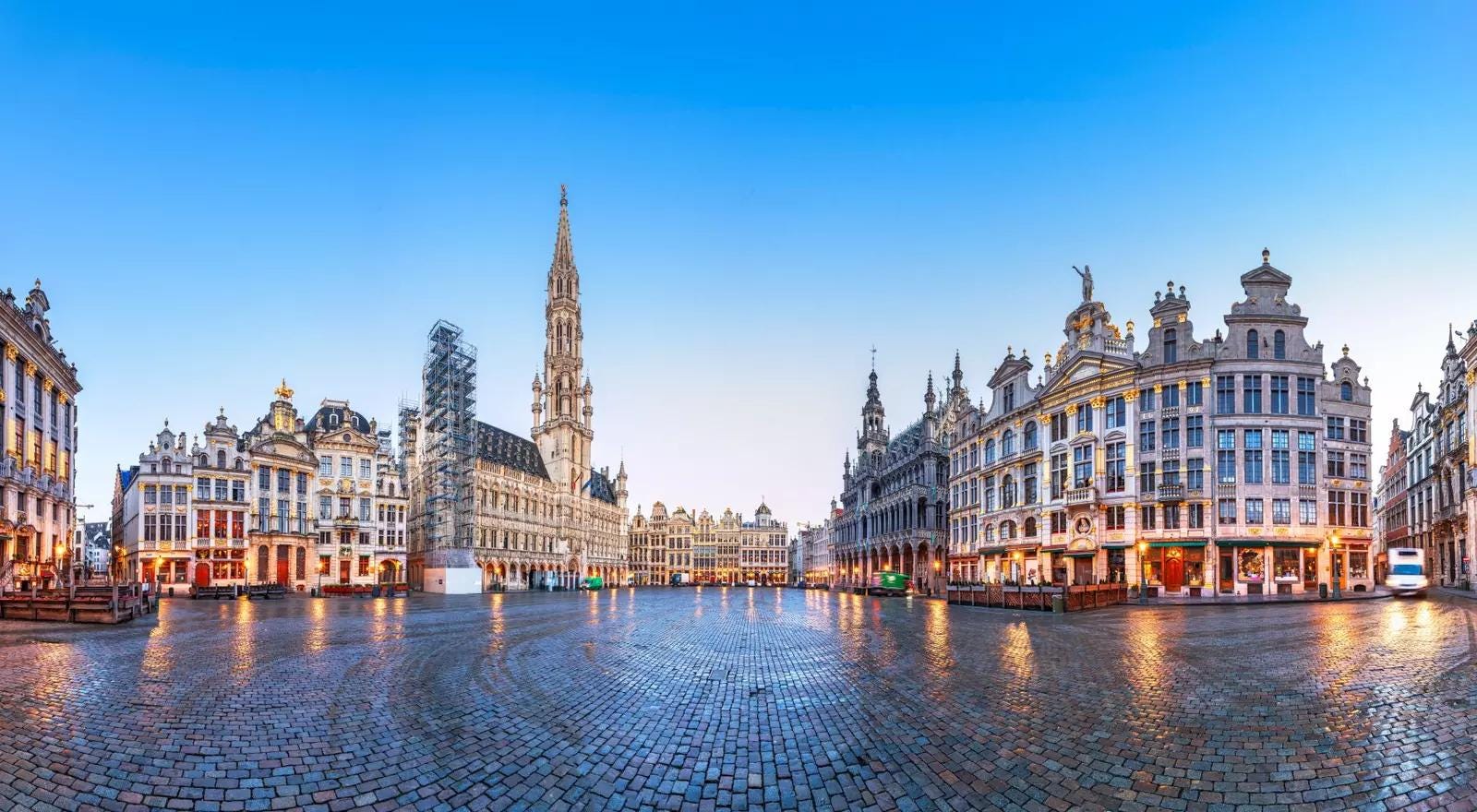
Look at the Grand-Place in Brussels.
Its famous guild houses possess elaborate façades and distinctive rooflines. Each building has its own character but together they form one of the most impressive urban spaces in Europe.
The square developed over centuries and much of its present appearance followed reconstruction after the French bombardment of 1695.
Despite the variety of its buildings the surrounding architecture forms a remarkably coherent ensemble.
This is an important lesson for modern town planning.
You do not need to make every building identical to create a beautiful public space.
You need enough shared architectural language for the buildings to look as though they belong to the same place.
Beauty is that reasoned harmony of all the parts within a body, so that nothing may be added, taken away, or altered, but for the worse. … It is the great and elegant order of the parts, fitted together with such proportion that nothing can be added, diminished, or changed without impairing the grace of the whole.
— Leon Battista Alberti, De re aedificatoria, Book VI (the classic definition of concinnitas)
Alberti is not asking for identical façades. He is asking for a whole in which difference is held by proportion, so that the square reads as one body rather than a row of competing objects.
5. The Ground Floor Must Be Interesting
So far we have looked at the square from a distance.
But what happens when you actually walk around it?
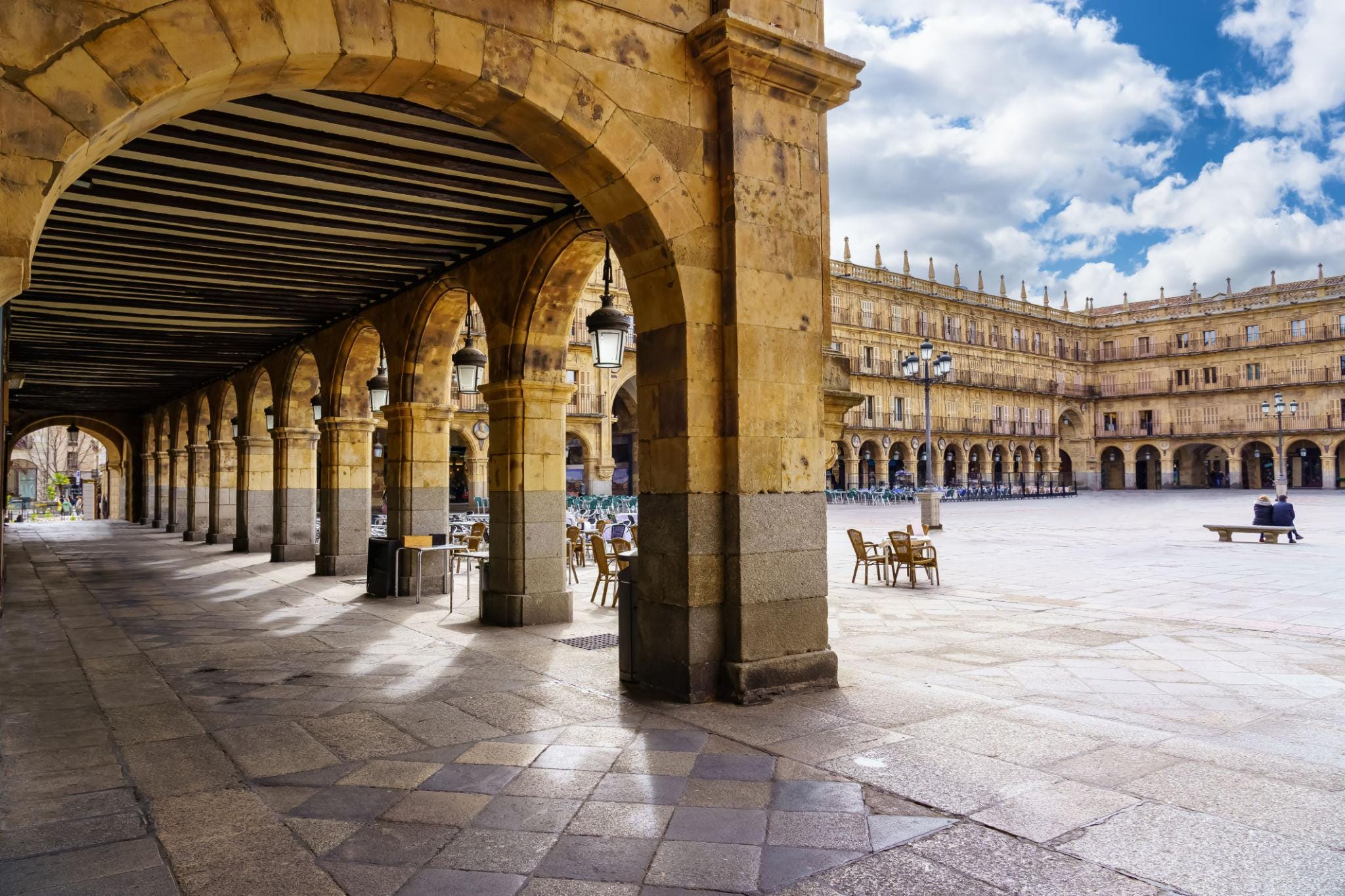
This is where the ground floor becomes particularly important because it is the part of the architecture people experience most closely.
Traditional town squares frequently placed shops beneath the surrounding buildings while entrances opened directly onto the public space. Arcades provided shelter from the weather and made it possible to walk around the square while remaining close to the activity inside.
The Plaza Mayor in Salamanca is a wonderful example.
Its eighteenth-century Baroque façades rise above continuous arcades that contain cafés and other businesses. People can walk beneath the arches while the open square remains available for gatherings.
The architecture therefore creates two different experiences.
You can stand in the middle and appreciate the grand composition or move around the edges where the buildings become part of everyday life.
This is something many modern plazas struggle to achieve.
A large public space surrounded by blank walls offers very little reason to remain there. Even if the paving is attractive the surrounding buildings provide nothing interesting to discover.
Historic squares worked because their edges were full of life.
And that life gave people reasons to return throughout the day.
Under the seeming disorder of the old city, wherever the old city is working successfully, is a marvelous order for maintaining the safety of the streets and the freedom of the city. It is a complex order. Its essence is intricacy of sidewalk use, bringing with it a constant succession of eyes. This order is all composed of movement and change, and although it is life, not art, we may fancifully call it the art form of the city and liken it to the dance—not to a simple-minded precision dance with everyone kicking up at the same time, twirling in unison and bowing off en masse, but to an intricate ballet in which the individual dancers and ensembles all have distinctive parts which miraculously reinforce each other and compose an orderly whole. The ballet of the good city sidewalk never repeats itself from place to place, and in any one place is always replete with new improvisations.
— Jane Jacobs, The Death and Life of Great American Cities (1961)
Jacobs is writing about a street, but the lesson travels. A square stays alive only if its edge keeps offering small reasons to pause: a shop, a door, a café, a window, another pair of eyes.
6. A Beautiful Square Needs Somewhere to Sit
One of the simplest ways to judge a public square is to watch what people do when they arrive.
Do they immediately cross to the other side or do they find somewhere to sit?
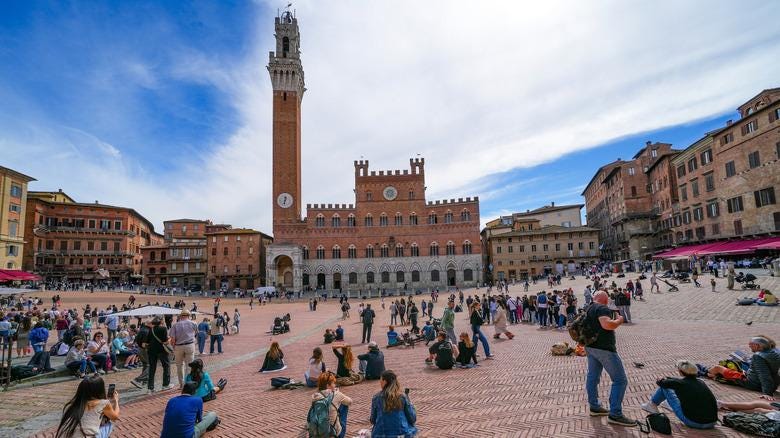
The most successful historic squares offer people opportunities to remain without requiring them to participate in a particular activity.
In Siena visitors sit directly on the sloping brick pavement of the Piazza del Campo. Others gather around the Fonte Gaia while people in the surrounding cafés watch the square from beneath the buildings.
The square accommodates all these different activities without requiring an elaborate arrangement of modern street furniture.
Its architecture already makes spending time there enjoyable.
The same principle appears in smaller Italian piazzas where a fountain provides a natural gathering point. A church entrance might have broad steps that become an informal place to sit while the surrounding buildings provide shade during the warmer hours.
These details matter because a square should be comfortable as well as beautiful.
People need places where they can rest and watch the life of the city.
And when enough people begin doing that the square becomes more than a space between buildings.
It becomes somewhere people actually want to be.
Only when opportunities for sitting exist can there be stays of any duration. If these opportunities are few or bad, people just walk on by. The existence of good opportunities for sitting paves the way for the numerous activities that are the prime attractions in public spaces: eating, reading, sleeping, knitting, playing chess, sunbathing, watching people, talking, and so on. Good places to sit and rest are very definitely a question of good benches—and inviting ones. … The entire square is built like a grandstand—a shell with places for standing and sitting at the top, along the façades at the shell’s periphery.
— Jan Gehl, Life Between Buildings (1971)
Gehl’s Campo comparison is almost a description of Siena. Sitting is not street furniture added later. It is the condition that turns a crossing into a place.
7. The Square Must Belong to the City Around It
Finally we come to a principle that is easy to overlook.
A beautiful town square should feel like a natural part of the surrounding streets.
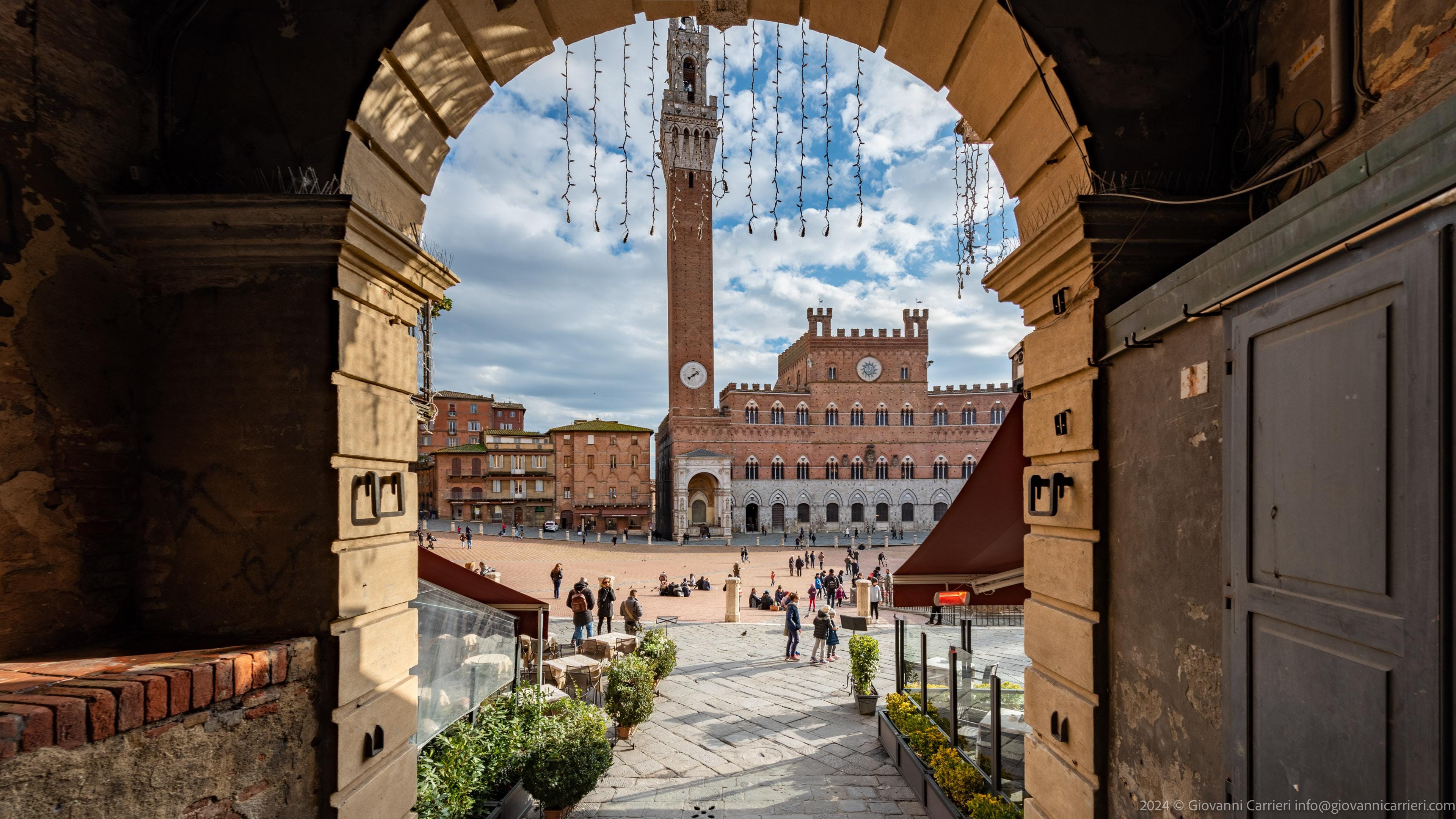
In medieval European cities public squares were usually connected to a network of narrow streets and passages. You might approach through a relatively modest street before suddenly emerging into a magnificent open space.
That transition was part of the experience.
Consider the Piazza del Campo once again.
Several streets lead into the square from different directions and the surrounding medieval city remains closely connected to it. You can walk through Siena’s narrow streets before arriving at the enormous curved piazza almost unexpectedly.
The contrast makes the square feel even more impressive.
Venice provides another excellent example.
The narrow streets around Piazza San Marco create a very different experience from the openness of the square itself. As you emerge from the surrounding passages the scale of the architecture becomes immediately apparent.
This is one reason historic squares can feel so much more interesting than modern plazas surrounded by wide roads.
The older squares belong to a continuous pedestrian environment.
You can arrive on foot and continue exploring the surrounding city without constantly encountering barriers created for traffic.
Their beauty therefore depends partly on what happens beyond their boundaries.
A square cannot become the heart of a city if the city around it makes reaching that heart unpleasant.
A town needs public squares; they are the largest, most public, rooms that the town has. But when they are too large, they look and feel deserted. … Make a public square much smaller than you would at first imagine; usually no more than 45 to 60 feet across, never more than 70 feet across. This applies only to its width in the short direction. In the long direction it can certainly be longer. … Build buildings round the square in such a way that they give it a definite shape, with views out into other larger places. … The life of a public square forms naturally around its edge. If the edge fails, the space never becomes lively.
— Christopher Alexander, A Pattern Language (1977), patterns 61 and related edge patterns
Alexander’s sizes are stricter than Siena or Venice, which he treats as exceptions for cities already dense with people. The principle still holds: the square only works if it is stitched into a walkable fabric of streets, edges, and smaller rooms.
If these essays have changed the way you see the world around you, the paid tier goes further.
You get longer, more researched pieces on the places that shaped Western civilization and the stories behind them. Deep dives into tradition, craftsmanship, and what the built world reveals about culture. Travel guides that teach you to actually read the places you visit.
This project is kept alive by people who care about old-world traditions. For a few dollars a month, you can be one of them.
Why We Should Build Beautiful Squares Again
Once you begin looking at Europe’s historic town squares through these seven principles you realize that their beauty is rarely accidental.
The surrounding buildings create enclosure while their proportions give the space a comfortable scale. An important building establishes a focal point and the neighboring façades create a coherent architectural setting.
Meanwhile the ground floors make the edges interesting and the square itself gives people somewhere to spend time. The surrounding streets then connect the public space to the everyday life of the city.
All these things work together.
And the remarkable part is that none of them requires a particular historical style.
A town square can be Gothic or Baroque and still follow many of the same principles. Its buildings might be constructed from brick or stone while the overall composition remains beautiful.
The real lesson is that traditional European builders understood public space as something that deserved careful architectural design.
They recognized that the space between buildings mattered just as much as the buildings themselves.
Today we spend enormous amounts of money constructing public plazas and redesigning urban spaces. Yet many of these projects struggle to create the kind of atmosphere that an ordinary historic square achieved centuries ago.
Perhaps the solution is simpler than we think.
We should begin by studying the places people already love and understanding the principles that make them work.
Because the beautiful town squares of Europe were built by people who understood something fundamental about cities.
A great square is an outdoor room that an entire city can call its own.
A city can only be reconstructed in the form of urban quarters. A large or a small city can only be reorganized as a large or a small number of urban quarters; as a federation of autonomous quarters. Each quarter must have its own center, periphery and limit. Each quarter must be a city within a city. … Locate public buildings, monuments, fountains on public squares, on prominent spots and in the focus of major vistas. … Frame central squares and high streets with narrow lot- and block-fronts. Reserve ground floors and mezzanines of central square and high-street buildings for non-residential uses.
— Léon Krier, on the urban quarter (widely cited formulation; the last three lines from his community-design checklist)
Krier’s closing claim is the practical version of the essay’s last sentence. A square becomes the city’s room only when the quarter around it has a center, an edge, and a life that can reach it on foot.
Beauty and the budget should never be enemies.
Sadly, most modern plazas aren't financed to last 30.
Europe certainly has some spectacular sites!