

Walk through almost any old European city and you will notice that even the most ordinary buildings can be remarkably beautiful.
Take a typical nineteenth-century apartment building in Paris. It might have five floors and a rather simple arrangement of windows; yet somehow the whole façade feels carefully designed and pleasant to look at.
Now compare that with a modern apartment building of roughly the same size.
Both buildings need windows and an entrance while both must provide enough space for the people living inside. Yet one might become a beloved part of the street while the other feels like an enormous box with holes cut into it.
So what makes the difference?
For centuries architects developed ways of arranging the outside of a building so that every part belonged to a larger composition. The position of the windows mattered just as much as the proportions of the wall around them; even the simplest doorway could become an important part of the design.
And once you begin noticing these things you start seeing them everywhere.
Here are five of the most important principles behind a beautiful façade:
1. Proportion: Getting the Shape Right
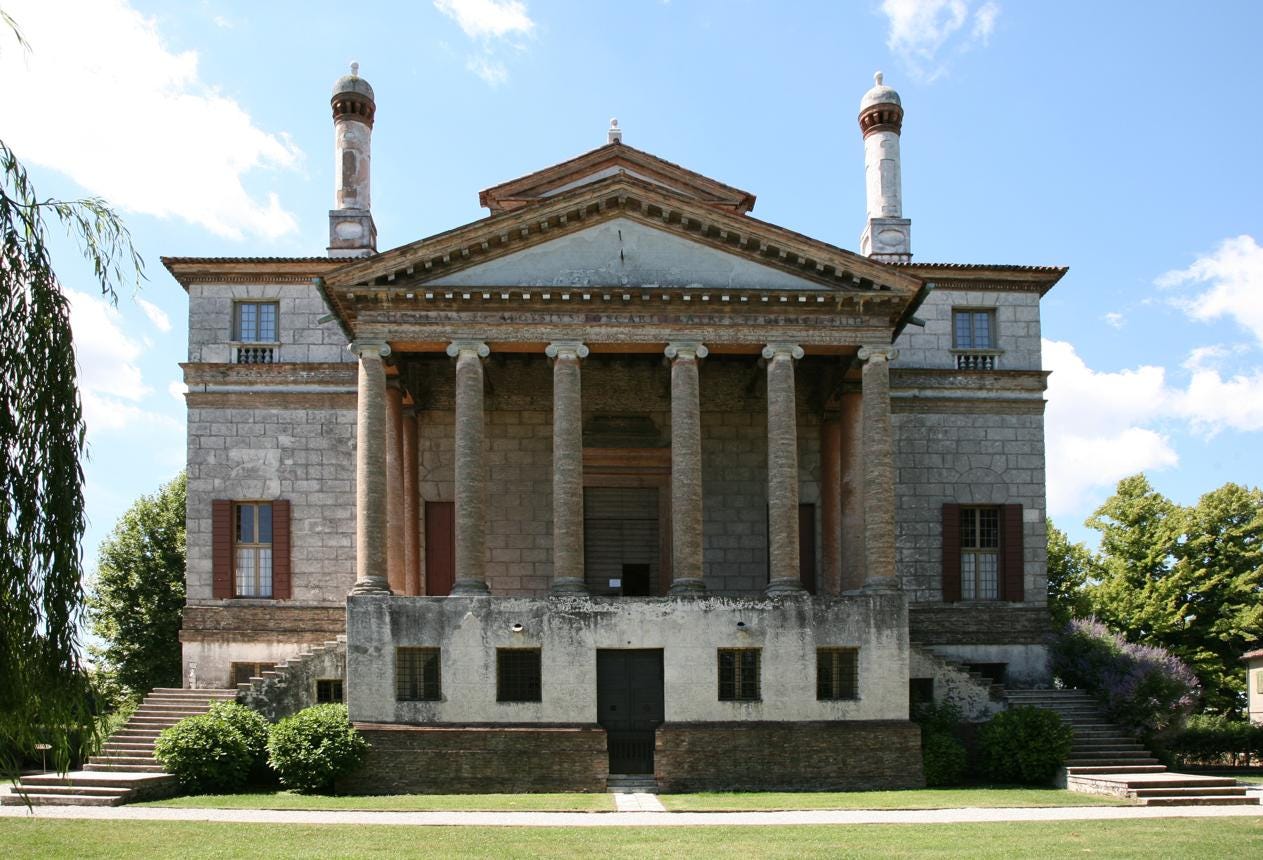
In the sixteenth century the Italian architect Andrea Palladio became famous for designing some of the most beautiful villas in Europe.
His buildings were usually quite simple in their basic arrangement. A central entrance established the main axis while windows and columns followed a carefully organized system; what made the result beautiful was the relationship between the individual parts.
Palladio believed that architecture should possess the same kind of mathematical harmony found in music.
Andrea Palladio, preface to Book IV of The Four Books of Architecture (Isaac Ware translation, 1738):
“And indeed, if we consider this beautiful machine of the world, with how many wonderful ornaments it is filled, and how the heavens, by their continual revolutions, change the seasons according as nature requires, and their motion preserves itself by the sweetest harmony of temperature; we cannot doubt, but that the little temples we make, ought to resemble this very great one, which, by his immense goodness, was perfectly compleated with one word of his; or imagine that we are not obliged to make in them all the ornaments we possibly can, and build them in such a manner, and with such proportions, that all the parts together may convey a sweet harmony to the eyes of the beholders, and that each of them separately may serve agreeably to the use for which it shall be appointed.”
In The Four Books of Architecture he explained how rooms could be designed using related dimensions and how the different parts of a building should form a coherent whole. His preferred proportions included ratios such as 1:1 and 2:3; these relationships helped architects organize spaces without making every room identical.
The same principle applies to a façade.
A window can be beautiful on its own but still look wrong if it is too large for the wall surrounding it. Similarly a doorway might possess beautiful carving while appearing strangely small compared with the building above.
Traditional architects therefore paid close attention to the relationship between openings and the masonry around them.
Look at the Palazzo Rucellai in Florence.
Leon Battista Alberti designed its façade in the fifteenth century and organized the exterior with repeated pilasters and horizontal divisions. Each floor belongs to the same underlying composition; the result is a building whose individual parts make sense together.
This is the first secret of a beautiful façade.
Before you begin adding decoration you need to get the proportions right.
2. Rhythm: Making the Windows Work Together
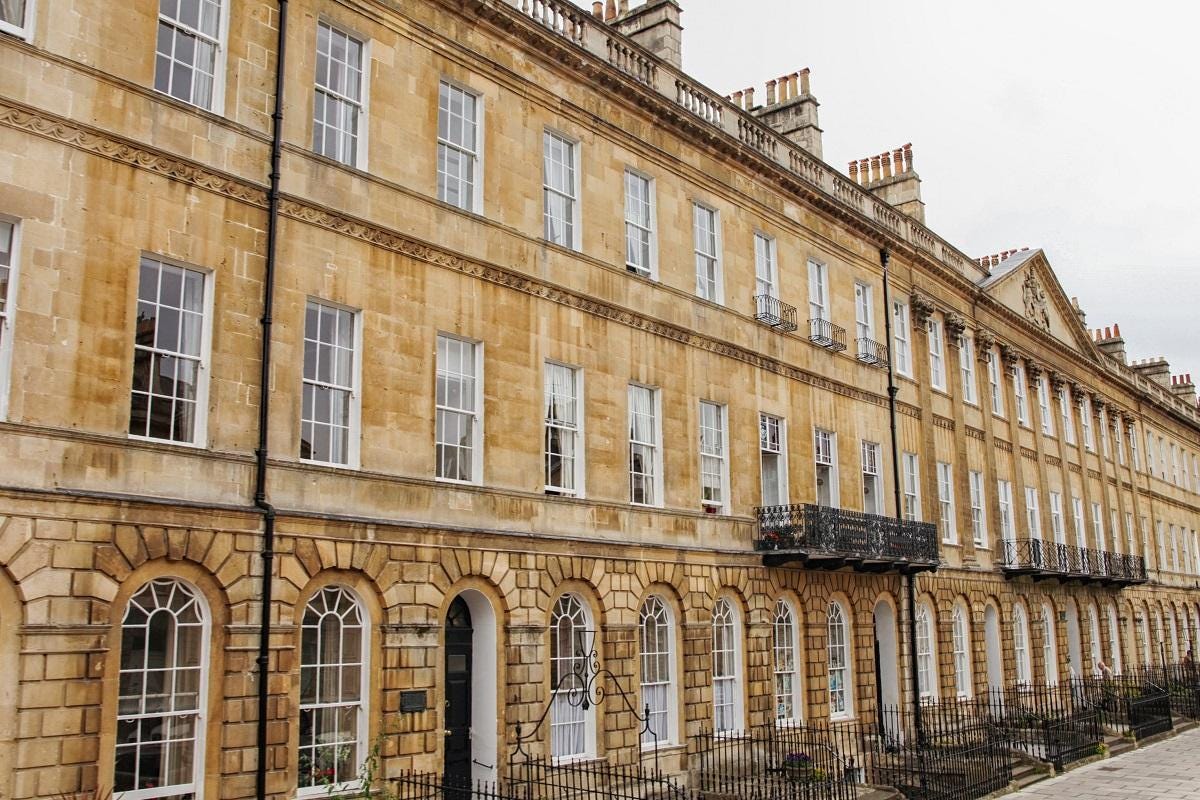
Now imagine walking along a street in Bath.
The buildings may extend for hundreds of feet and contain dozens of individual homes; nevertheless the street often feels like one carefully designed composition.
A large part of that comes down to the windows.
Traditional façades usually arrange their openings according to a recognizable rhythm. Windows repeat at regular intervals while the spaces between them follow a similar pattern; the eye can therefore move across the building without constantly encountering something unexpected.
Vitruvius, De architectura, Book I, Chapter II (Morris Hicky Morgan translation, 1914):
“Architecture depends on Order, Arrangement, Eurythmy, Symmetry, Propriety, and Economy. Order gives due measure to the members of a work considered separately, and symmetrical agreement to the proportions of the whole. It is an adjustment according to quantity. By this I mean the selection of modules from the members of the work itself and, starting from these individual parts of members, constructing the whole work to correspond. Arrangement includes the putting of things in their proper places and the elegance of effect which is due to adjustments appropriate to the character of the work. Eurythmy is beauty and fitness in the adjustments of the members. This is found when the members of a work are of a height suited to their breadth, of a breadth suited to their length, and, in a word, when they all correspond symmetrically.”
This becomes especially important on long façades.
A wall stretching across an entire city block can feel enormous if nothing divides it into smaller sections. Arrange the windows into repeated bays and suddenly the same wall becomes much easier to understand.
Georgian architects were particularly good at this.
They could design a row of relatively ordinary houses and give the entire street a sense of unity through consistent window placement. Individual homeowners might decorate their entrances differently; the larger rhythm still held everything together.
Paris offers another excellent example.
During the nineteenth century the new apartment buildings along Haussmann’s boulevards followed common rules concerning height and alignment. Their windows created repeated patterns across the street while balconies helped connect neighboring façades.
The interesting thing is that repetition did not require every building to look identical.
Architects could vary the details around individual windows while preserving the underlying rhythm.
And that is what makes this principle so useful.
You can create an interesting façade with very little ornament if the windows themselves form a beautiful composition.
If these essays have changed the way you see the world around you, the paid tier goes further.
You get longer, more researched pieces on the places that shaped Western civilization and the stories behind them. Deep dives into tradition, craftsmanship, and what the built world reveals about culture. Travel guides that teach you to actually read the places you visit.
This project is kept alive by people who care about old-world traditions. For a few dollars a month, you can be one of them.
3. Hierarchy: Giving the Building a Beginning and an End
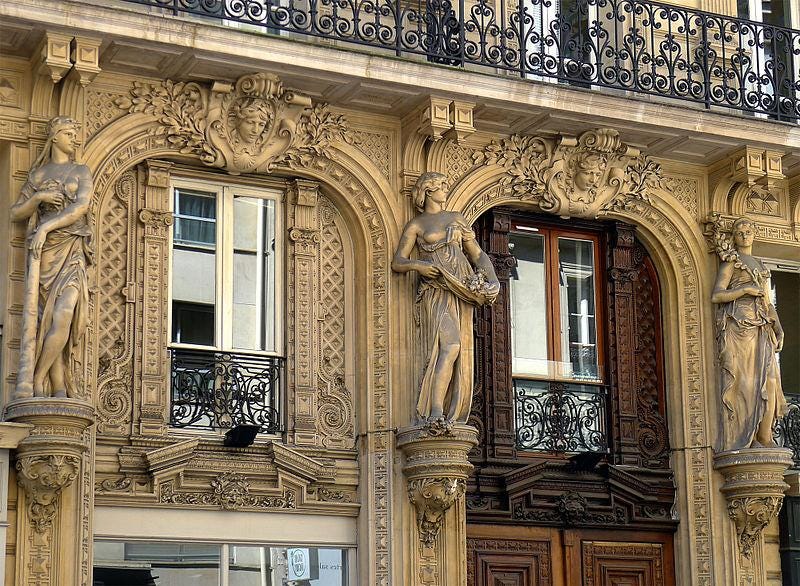
One of the easiest ways to recognize a traditional building is to look at how its different floors are treated..
Continue reading below.