


Intro
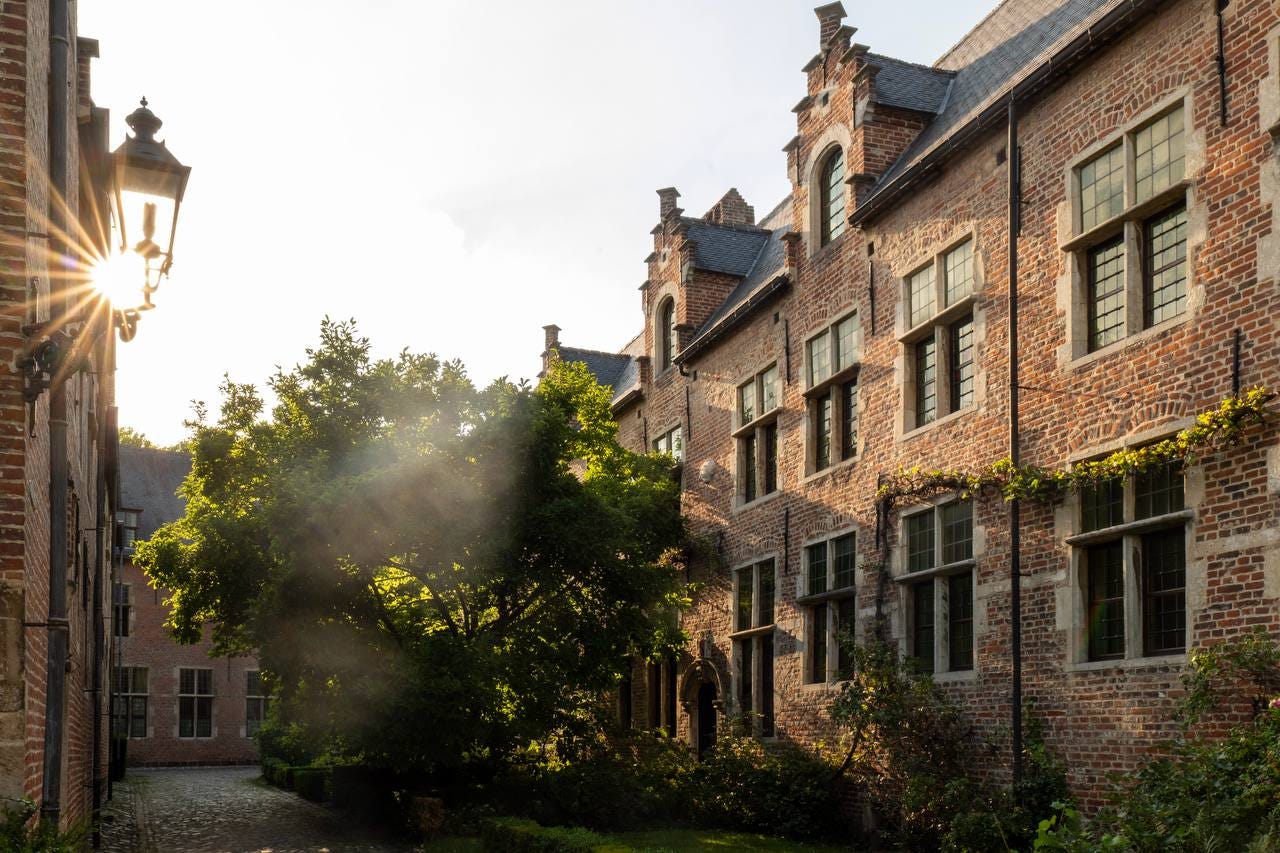
While wandering through Flemish cities, one might stumble upon an oasis of peace: cobbled streets, courtyards, and the only sounds are the rustling of leaves and the distant toll of church bells, just a street away from the bustle of the city. These are beguinages, often nicknamed “villages within cities.” The origins of beguinages can be traced to the 12th and 13th centuries when a group of religious women called the beguines searched for a life of piety and community outside the walls of monasteries. Unlike being a nun, being a beguine was completely voluntary and often temporary. They were free to leave and even marry if they wished. This made their lifestyle both radical and unique for its time. The beguinages became a safe haven where these women could live, work, and pray together.
Origins
The first beguinages appeared during the 12th and 13th centuries, particularly in Western Europe. Across the continent, this period was marked by rapid urban growth but also social unrest. Wars, the Crusades, and famine created a disproportionate number of women compared to men, leaving many widowed or unmarried. At the time, the traditional paths for women were either marriage or convent, but since many could not get married or found a life in a monastery too isolating, a new path emerged: becoming a beguine. These were laywomen who wanted to live devout lives while remaining engaged with the world around them. The beguinages had no precise founder or origin. It is something that emerged out of necessity, and this movement would permanently shape medieval civil life across Europe.
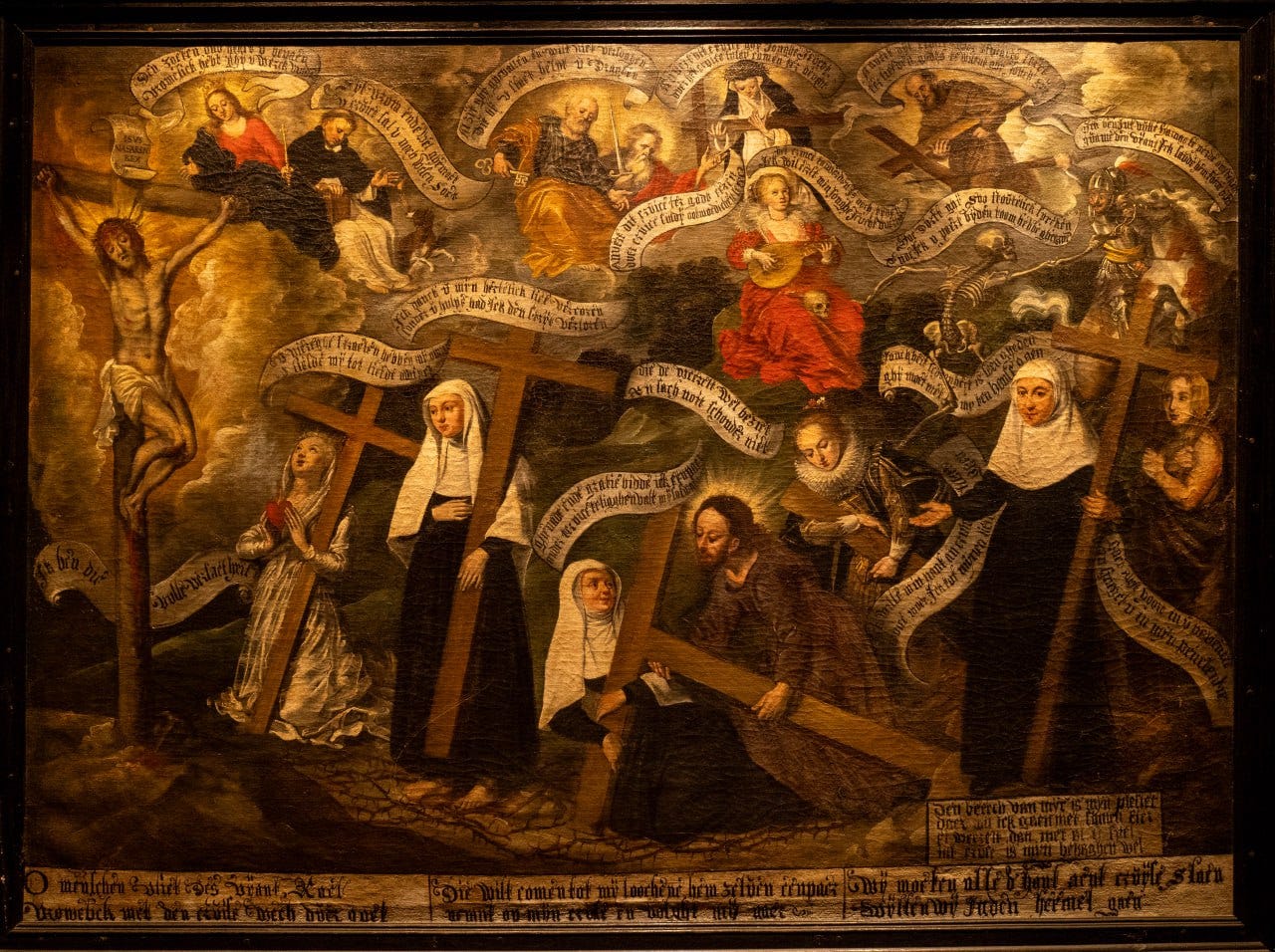
The term “beguine” comes from the Flemish begijn, but the same concept was also seen in places like Lombardy with Humiliata, Bizzoca in Tuscany, and France with Papelarde (likely from their craft in papermaking), though we use the Frenchified version of the Flemish word in English: beguine. It is also worth noting that this idea of community was not limited to women. Men who had suffered great hardships or were unable to work due to age or health could become Beghards, though they were more closely connected to guilds as opposed to the Church.
Unlike nuns, beguines did not take formal lifelong vows. They could freely leave the community, marry, or even earn a living if they wished. This independence was remarkable and exceptional for its time. Most worked by caring for the sick, educating the youth, and through crafts like weaving and brewing. In this way, beguines were not only participating in society but also actively contributing to it wherever they could.


Life and Role of Beguinages
Life inside the beguinages was simple and quiet, yet also active. Since the beguinal movement had no single founder or central authority, it lacked a uniform set of rules. Life varied from beguinage to beguinage, but the goal was always the same: a secluded, devout life in the heart of the city.
The beguines lived in community through work, mutual support, and prayer. Some earned a living through crafts such as lace-making, weaving, and brewing, while others worked as teachers, nurses, and caregivers. Their income and work helped fund local economies and their community became more than simple religious enclaves. They became closely tied to the civic and economic life of the Low Countries.
At its height, the beguinal movement was far from small. In Brussels, beguines once made up nearly five percent of the city’s entire population, which was estimated at around 30,000. Across the Rhine, the movement spread widely as well. In what is now western Germany, there were thought to be more than 200,000 beguines. This was a mass movement that shaped the social and religious fabric of late medieval Europe.
Their independence and individuality, however, sometimes provoked suspicion. Apart from the priests who led their churches, men were largely absent from these communities, which some clerics regarded with unease. From time to time, beguines faced criticism or even persecution, but their service to the sick, the poor, and the young made them indispensable to society. Still, while the movement spread widely across medieval Europe, only in the Low Countries did beguinages survive with relative stability. This endurance explains why most of the beguinages we see today are found almost exclusively in Flanders and Brabant.
Architecture
Beguines lived in modest brick houses, designed for simplicity and modesty. In smaller beguinages, the dwellings were often arranged in a rectangular formation around a central courtyard, with a church or chapel in the centre. This is the case in Bruges and Antwerp. Larger communities, such as Leuven’s Great Beguinage—the largest in Belgium—grew into something closer to a village, with winding cobbled streets, small squares, gardens, wells, and even canals.
Most of the surviving buildings date from the 13th to 16th centuries, reflecting the dominant architectural styles of their time: Gothic churches, Baroque gables, and vernacular brick houses create a distinctly Flemish atmosphere. The result is a unique urban landscape: neither monastery nor neighbourhood, it is something in between, a haven of peace and prayer woven into the fabric of a city.


UNESCO
Thanks to their immense importance to daily life during the Middle Ages and their lasting architectural legacy throughout the Low Countries, many beguinages were awarded the title of World Heritage Site in 1998. The designation includes thirteen sites across Flanders, listed under the single entry “Flemish Beguinages”:
Bruges
Dendermonde
Diest
Ghent:
New St. Elizabeth
Our-Lady Ter Hooyen
Hoogstraten
Lier
Leuven
Mechelen
Kortrijk
Sint-Truiden
Turnhout
Tongeren
Not every beguinage was included in the UNESCO list. Some were excluded because they are too small, not sufficiently preserved, or have disappeared completely. Examples include the smaller beguinages of Leuven, Mechelen, and Ghent, as well as sites in Tienen and Aarschot.
Beguinages Today
As the number of beguines dwindled, the movement gradually faded into history. Many beguinages were abandoned and fell into disrepair. Some were demolished, while others were repurposed. In Leuven, the Great Beguinage was almost entirely deserted, with only a handful of beguines remaining.
In the 1960s, the University of Leuven proposed to restore the neighbourhood in exchange for ownership of the site. The government accepted, and the project transformed the beguinage from near ruin into a preserved historic quarter. The last beguine passed away in the 1980s.
Today, the Great Beguinage is one of the best-kept examples in Europe. It houses students, professors, and university visitors, while remaining open as a quiet place to walk and wander. Demand for rooms is so high that there is even a waiting list to live there.
Other beguinages across Flanders have found new life as well. Bruges and Ghent’s beguinages are now protected heritage sites, their whitewashed and brick houses still inhabited but also open to visitors. In Mechelen and Tongeren, the beguinages continue as residential quarters. The beguinage of Aarschot, meanwhile, has been converted into a nursing home, a reminder that these spaces of care and community continue to serve people even in new forms. While beguines may no longer exist, their spirit of calmness and community lives on in different forms.


Final Reflection
Architecturally, beguinages form a distinct urban type shaped by historical circumstance rather than theory. Their enclosed courtyards, narrow streets, and uniform building scale reflect a way of organizing space around daily routines, shared work, and communal life. Built with modest materials and restrained forms, they rely on repetition and enclosure rather than monumentality to create order. This clarity allowed beguinages to adapt over centuries, surviving social and religious change with minimal alteration. Today, they stand as historical evidence of how architecture once supported stable civic life, balancing privacy and community through careful spatial design.
Thanks for your post. I enjoyed reading.🙂
Fascinating. Thank you so much